 (+035) 527-1710-70
 NEWSLETTER


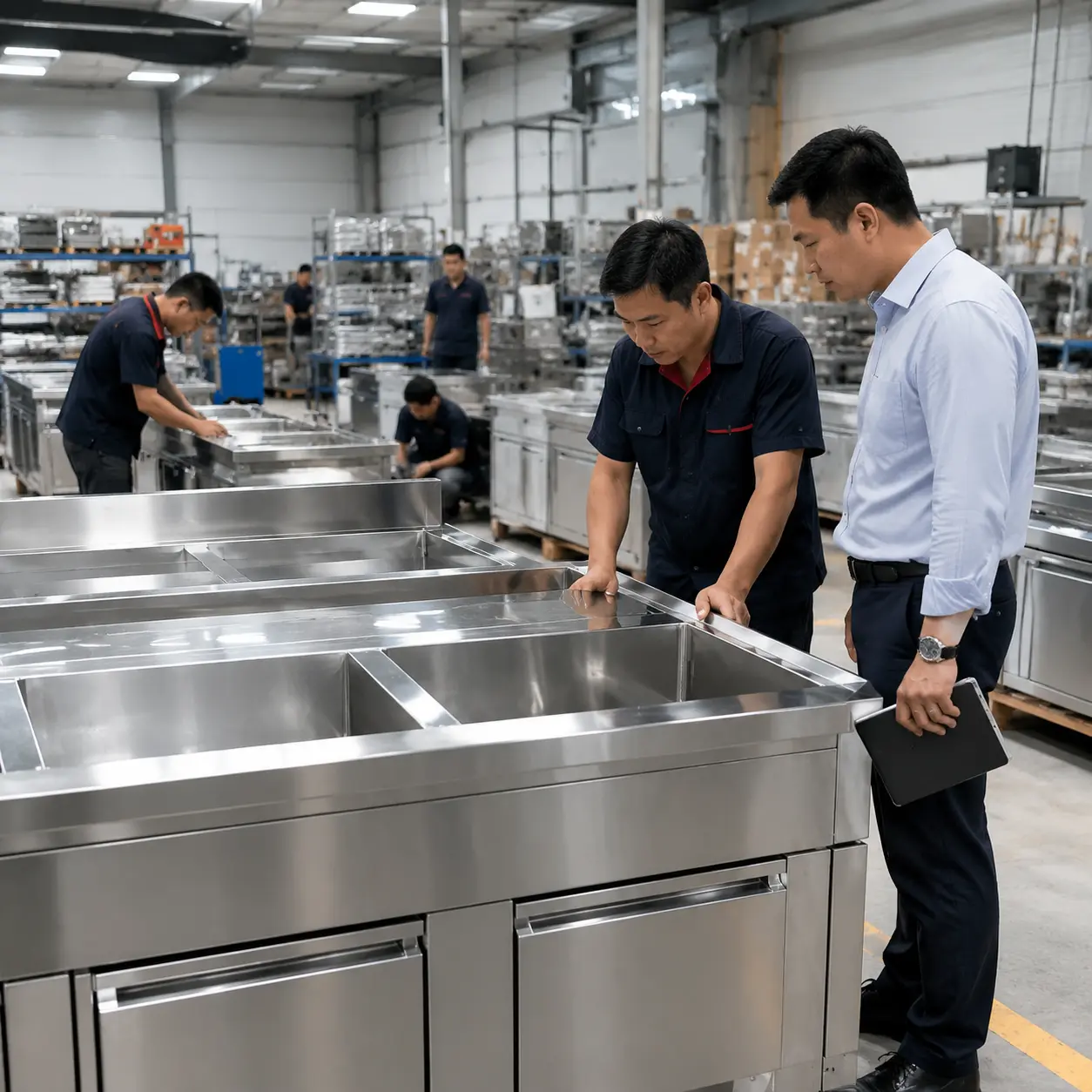
To compare commercial kitchen equipment suppliers properly, do more than place several product links and prices side by side. A useful comparison connects each supplier to your menu, expected throughput, available utilities, destination-market requirements, budget, and service model. It also tests whether the supplier can support the equipment after shipment.
For a foodservice equipment importer or distributor, the objective is not simply to find a product that appears suitable. You need evidence that the supplier understands the application, can produce to the quoted specification, can provide the required documents, and can respond when a customer needs parts or technical help.
1. Supplier identity: establish who you are buying from
Start with the supplier’s legal identity, operating location, product scope, and commercial role. Determine whether you are dealing with a manufacturer, trading company, distributor, project contractor, or a combination of these. The answer affects customization, minimum order quantities, lead times, quality control, and after-sales accountability.
Review the supplier’s official website, company registration information where available, business address, product categories, and named contacts. Look for consistency across the website, quotation, pro forma invoice, bank information, packaging marks, and shipping documents. Differences in company names or payment entities should be explained before an order is placed.
Guangzhou Yifeng Metal Technology Co., Ltd. presents itself as a commercial kitchen equipment manufacturer and exporter located in Baiyun District, Guangzhou, Guangdong, China. Its website describes product development, manufacturing, OEM/ODM support, and export-oriented service. The company states that it was founded in 2015; this is a company claim that should be confirmed through business documents or other appropriate checks before publication or procurement approval.
The company’s stated categories include baking equipment, hamburger shop equipment, refrigeration equipment, snack equipment, other kitchen equipment, and accessories. This range may be relevant to importers building a multi-category product line, but the breadth of a catalog does not by itself prove capability in every category. Ask which products are made in-house, which are sourced, and which processes are subcontracted.
Use the Guangzhou Yifeng Metal manufacturing background page as an initial reference, then request a current company profile, business license, export references, and the name of the person responsible for technical and after-sales communication.
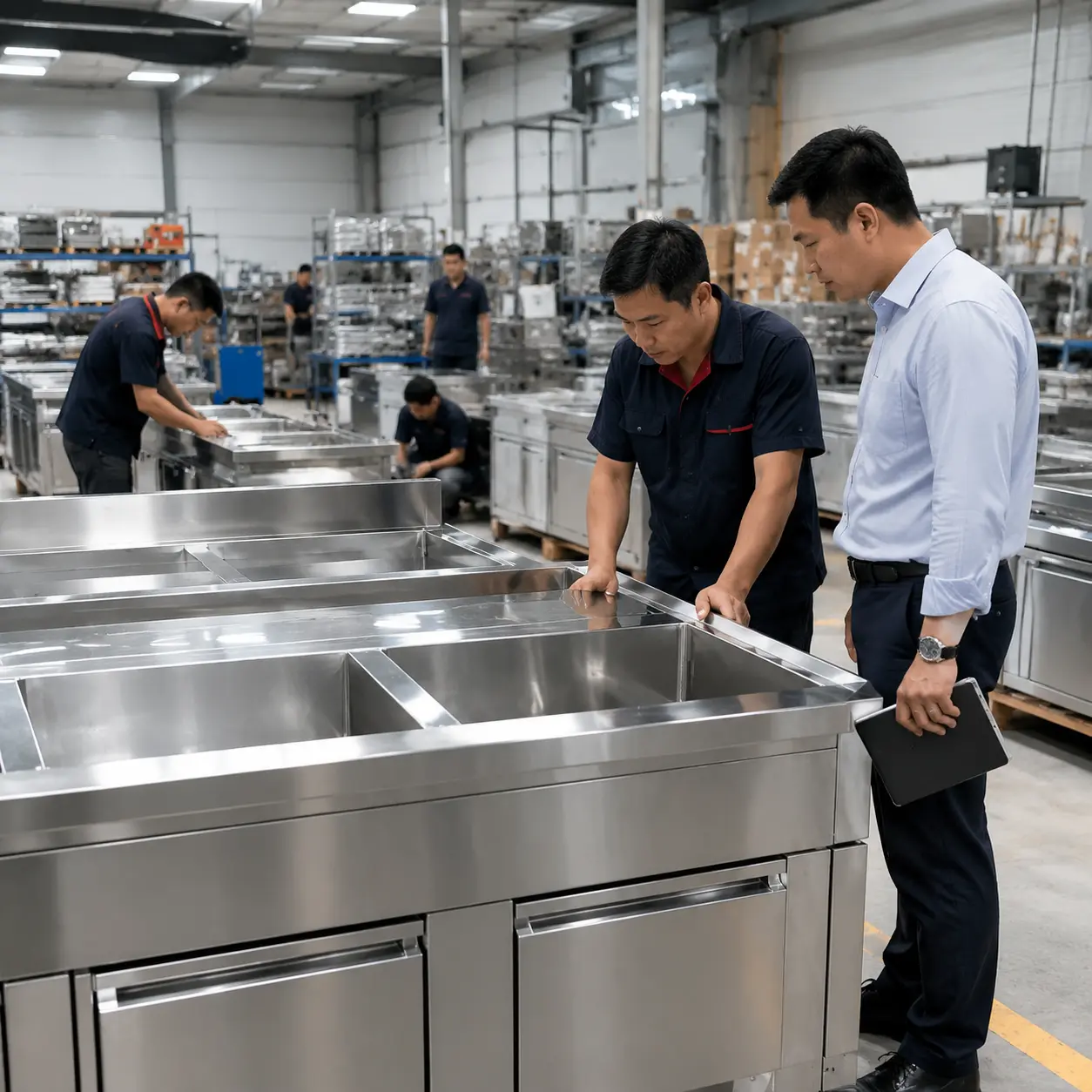
Commercial kitchen equipment for foodservice buyers
2. Factory and process evidence: test the manufacturing story
A supplier comparison should distinguish between a factory claim and factory evidence. Ask for dated production-area photographs or video, process descriptions, equipment lists, quality-control records, and a live video call when a site visit is impractical. The goal is to understand how the supplier turns an approved drawing or specification into a finished machine.
Relevant process evidence may include incoming-material checks, sheet-metal cutting, forming, welding, surface treatment, assembly, electrical testing, functional testing, final inspection, and packing. Request sample inspection records that show what was checked, the acceptance criteria, and who approved the release. For customized equipment, ask how drawing revisions and customer approvals are controlled.
Guangzhou Yifeng Metal Technology Co., Ltd. describes capabilities including R&D, design, sheet-metal processing, laser cutting, bending, laser welding, and equipment manufacturing. Its website also refers to a factory area of approximately 20,000 square meters. These are manufacturer-stated details, so an importer should verify the facility, its usable production areas, and the relationship between the stated processes and the specific equipment being considered.
Do not rely on a general factory tour alone. Ask to see the production route for the actual product family. A supplier may have strong metal-fabrication resources while using third parties for refrigeration systems, burners, controls, compressors, or electrical components. That arrangement can be acceptable if it is disclosed and supported by documentation, warranty terms, and spare-parts planning.
Check the sample or inspection process before committing to a larger order. A practical sequence is: approve the technical specification, review drawings or product photographs, confirm a pre-production sample if needed, inspect the finished unit before shipment, and retain a signed inspection report. Define who pays for inspection and what happens if the equipment fails the agreed criteria.
3. Product evidence: compare usable capacity, not catalog language
Product comparisons often fail because suppliers describe capacity in different ways. For cooking equipment, clarify the batch size, loading method, cycle time, recovery time, temperature range, heating method, and operating assumptions. For refrigeration, request usable internal volume, temperature range, ambient conditions, refrigerant information, shelf layout, and power consumption under a defined test condition. For baking equipment, confirm tray dimensions, spacing, airflow, steam functions, and the actual number of trays used in the capacity claim.
Ask every supplier to complete the same specification sheet. Include model number, dimensions, net and gross weight, materials, electrical phase and frequency, voltage, rated power, gas requirements where relevant, water and drainage connections, controls, included accessories, packaging method, and installation requirements. If a value is not applicable, require the supplier to mark it as such rather than leaving the field blank.
Match the equipment to the menu and service period. A machine that performs adequately for a small snack operation may not support a high-volume burger shop, bakery, hotel kitchen, or central production facility. Consider peak-hour demand, not only average daily volume. Also check whether the destination market has restrictions on voltage, plugs, gas type, refrigerants, food-contact materials, electrical safety, or language requirements for manuals and labels.
Certification must be checked by scope and model. Do not treat a logo, certificate image, or general statement as proof that every product complies with a destination-market requirement. Ask for the certificate number, issuing body, covered model numbers, date, factory or manufacturing site, and any conditions of use. NSF publishes food equipment standards that can help identify relevant sanitation and design requirements; it should not be cited as evidence that a particular supplier or model is certified unless the applicable listing or certificate is verified.
Guangzhou Yifeng Metal Technology Co., Ltd. refers to BSCI and other certificates on its website. Request copies, confirm the issuing organization, verify the site and validity period, and determine whether the document concerns social compliance, product safety, management systems, or another subject. A certificate for one facility or product should not automatically be applied to another.
Review the supplier’s commercial kitchen equipment products and GZYF Metal equipment portfolio, but use them as starting points for a technical request rather than as a substitute for model-specific documentation.

Commercial kitchen equipment for foodservice buyers
4. Quotation and after-sales checks: require a complete commercial offer
A generic quotation is difficult to compare and often creates unexpected costs. Require each supplier to quote the same equipment list, specifications, quantity, Incoterm, destination, packaging standard, payment terms, production lead time, quotation validity, and warranty basis. The quotation should identify what is included and excluded.
Ask separately about inland transport, export packing, documentation, inspection, freight, insurance, destination charges, installation, commissioning, training, taxes, and local service. Confirm whether spare parts are included in the price and whether replacement parts remain available after the model changes. Request a recommended spare-parts list for the first year of operation, including prices, lead times, and shipping method.
Warranty language should define the coverage period, start date, exclusions, labor responsibility, freight responsibility, response time, and process for diagnosing a fault. Ask whether support is provided by the manufacturer, a local agent, or a third-party service company. For importers and distributors, request exploded parts diagrams, wiring diagrams, manuals, troubleshooting guides, and remote technical support contacts.
Before issuing a purchase order, compare the supplier responses in a standard matrix. Score technical fit, documentation, certification scope, factory evidence, inspection arrangements, lead time, landed cost, warranty, spare-parts support, and communication quality. The lowest initial price may not produce the lowest operating cost if the unit requires difficult installation, has unclear utility requirements, or lacks serviceable parts.
When ready, use the request a commercial kitchen equipment quote page to submit a structured inquiry. Include the menu application, target capacity, destination country, utility conditions, quantity, required documents, preferred Incoterm, and inspection expectations. A complete request gives the supplier a fair opportunity to provide a specific quotation rather than a generic catalog response.

Commercial kitchen equipment for foodservice buyers
Practical decision rule
Select a supplier only when the identity, product specification, compliance documentation, production process, commercial terms, and after-sales plan can be connected in writing. If a critical field remains unclear, mark it as an open item and resolve it before approval. This discipline makes it easier to compare commercial kitchen equipment suppliers on evidence instead of presentation quality or headline price.
Once you have checked a supplier’s identity, manufacturing story, and product evidence, the next step is to test whether the supplier can support an actual purchase in your market. This is where many comparisons fail. A supplier may appear suitable in a catalog but still create problems through incomplete quotations, unclear certification scope, missing replacement parts, or delivery terms that do not match your opening schedule.
Use the following checks to compare commercial kitchen equipment suppliers on the risks that affect installation, operation, and long-term ownership.
1. Match compliance documents to the destination market
Do not ask only whether a product is “certified.” Ask which standard, mark, test report, or registration applies to the exact model and destination market. The relevant requirements can differ according to equipment type, electrical system, gas configuration, food-contact surfaces, sanitation rules, and local inspection practices.
NSF International maintains a portfolio of food equipment standards that can help buyers identify relevant requirements, but the existence of a standard is not proof that a particular supplier or model complies with it. Request the complete document and check:
- the legal manufacturer and manufacturing site;
- the exact model number and any permitted variants;
- the issuing or testing organization;
- the standard edition or regulatory basis;
- the validity period, where applicable; and
- whether the document covers the finished product or only a component.
The same discipline applies to social or factory-related certificates. If a supplier website refers to BSCI or another certificate, ask for the certificate, audit date, covered entity, covered site, and scope. A certificate connected to one facility or business entity should not automatically be treated as evidence for every product or location.
For imported equipment, also confirm whether the supplier can provide the documents your customs broker, electrical inspector, gas authority, or commercial landlord may require. Document responsibility should be written into the purchase agreement rather than left to email assumptions.
2. Require a sample, inspection, or approval process
Catalog photography cannot confirm construction details, controls, packaging, or service access. Before placing a significant order, define how the equipment will be approved. Depending on the purchase, this may involve a physical sample, a video inspection, a third-party inspection, or a pre-shipment documentation review.
Your approval checklist should compare the quoted product against the final specification, including:
- overall dimensions and installation clearances;
- electrical voltage, frequency, phase, plug, and connection requirements;
- gas type, inlet arrangement, and ventilation requirements where relevant;
- materials and finishes in food-contact or high-cleaning areas;
- controls, accessories, shelves, trays, baskets, or other included components;
- nameplate information and model identification; and
- packing method, labeling, and protection against transit damage.
Ask the supplier to identify which features are standard and which are optional. If you are developing a private-label product or expanding a distributor catalog, approve the artwork, nameplate, manual, packaging, and spare-parts list before production. The manufacturer’s website describes product development, OEM/ODM support, sheet-metal processing, laser cutting, bending, laser welding, and equipment manufacturing capabilities; treat those descriptions as capabilities to verify against your specific project, not as proof that every customization is available for every model.
For a new store opening, connect approval to the installation schedule. For replacement equipment, confirm whether the new unit fits the existing footprint, utilities, and workflow. For menu expansion, test the equipment against the actual batch size, service pattern, and cleaning routine rather than relying on a broad category label.
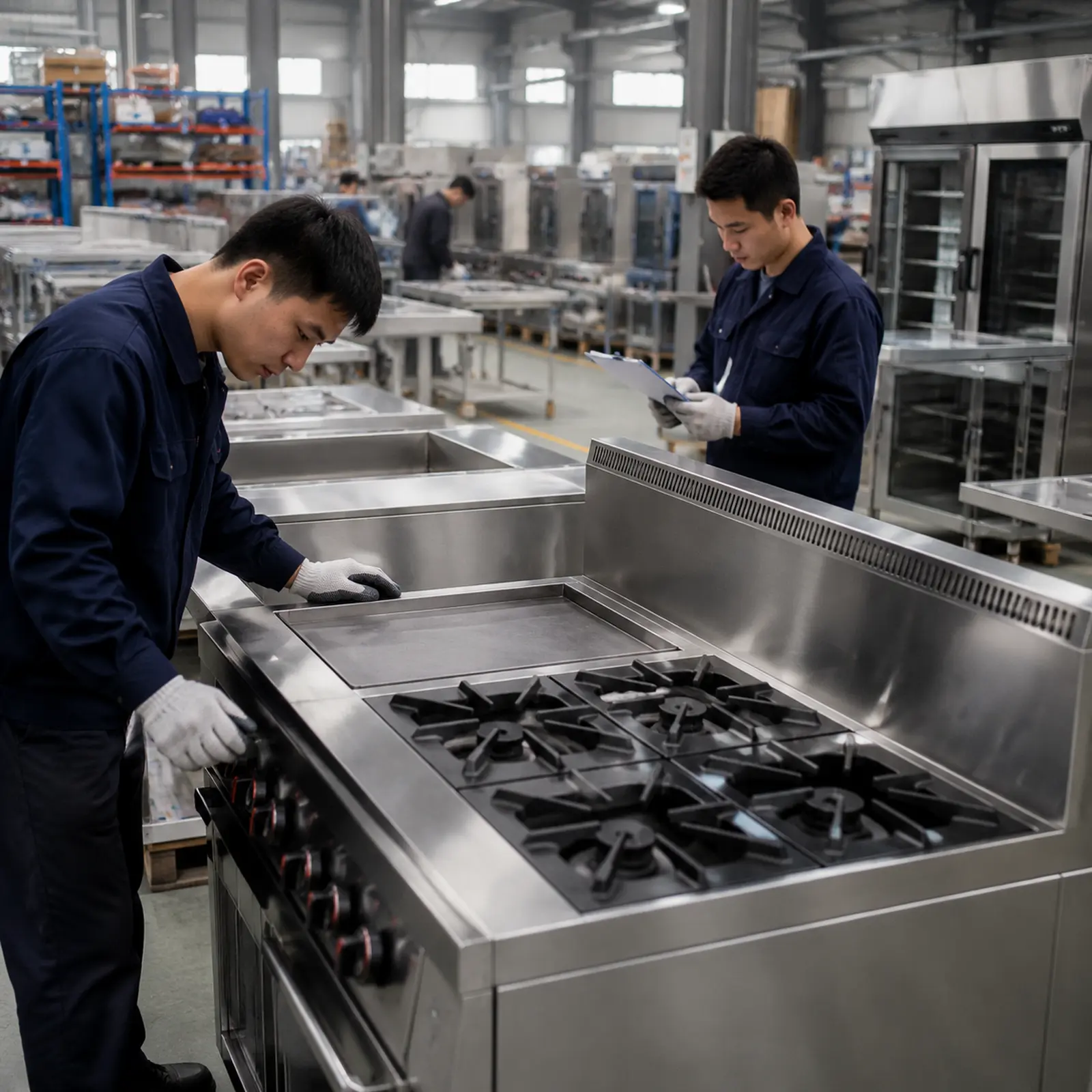
Commercial kitchen equipment for foodservice buyers
3. Compare the quotation line by line
A low unit price is not a reliable comparison if the competing quotations contain different inclusions. Ask each supplier to quote the same written specification and present the commercial offer in a comparable format.
A complete quotation should state:
- manufacturer, model, quantity, and revision number;
- unit price, currency, taxes, and applicable fees;
- included accessories, consumables, manuals, and spare parts;
- packaging method and shipping dimensions or weight, when available;
- trade term, named delivery location, and responsibility for freight or insurance;
- MOQ and whether mixed-model orders are permitted;
- production lead time and the event that starts the lead-time clock;
- payment schedule and conditions for approving production;
- quotation validity period; and
- warranty duration, exclusions, claim procedure, and remedy.
Clarify whether installation, commissioning, local service, import clearance, and training are included. If they are not included, record who is responsible. Also ask how engineering changes are handled after approval. A supplier should confirm whether a change affects price, lead time, certification, spare parts, or the approved drawing.
If several products are under review, use the compare commercial kitchen equipment function to organize the initial shortlist, then request a formal written quotation for the final specification. You can also review the broader commercial kitchen equipment products range and the GZYF Metal equipment portfolio before asking for model-specific documentation.
4. Test after-sales support before ordering
After-sales support is part of the equipment offer, not an optional courtesy. Ask practical questions before payment:
- Which parts are normally stocked, and where?
- Can the supplier provide an exploded parts diagram and parts list?
- How are warranty claims submitted and diagnosed?
- Who pays for replacement parts, freight, labor, or return shipping?
- What information is required for technical support?
- Can the supplier support discontinued or modified models?
- What response time should a buyer expect during a service issue?
Request operating and maintenance manuals in the language needed by your staff. For distributors and private-label buyers, ask whether manuals, labels, and spare-parts packaging can carry the approved brand and model information. Do not promise customers a service level that has not been confirmed in writing.
Practical decision rule
Choose the supplier that provides the strongest documented fit for your application, not simply the lowest initial price. A useful decision record scores each finalist on five weighted areas:
- Specification fit: Does the proposed model meet the operating, utility, space, and workflow requirements?
- Evidence quality: Are drawings, manuals, test documents, and model details complete and consistent?
- Commercial clarity: Are price, inclusions, lead time, MOQ, trade terms, and payment conditions explicit?
- Compliance readiness: Can the supplier support the documents and approvals required in the destination market?
- Lifecycle support: Are parts, warranty procedures, technical assistance, and ownership responsibilities defined?
Set a minimum pass level for compliance and documentation. A supplier that fails a mandatory safety or import requirement should not remain in contention because of a favorable price. If two suppliers remain comparable, use sample quality, communication discipline, confirmed lead time, and parts support as tie-breakers.

Commercial kitchen equipment for foodservice buyers
Frequently asked questions
Can a supplier prove the specification?
Yes, but the proof should connect to the exact model and purchase configuration. Request a specification sheet, drawing, manual, nameplate example, test document where applicable, and written confirmation of included accessories. Treat unsupported catalog language as a starting point for questions, not final evidence.
Which documents apply in my market?
That depends on the equipment category and destination. Confirm requirements with the local authority, inspector, importer, or qualified compliance professional. Ask the supplier to identify the documents it can provide, but independently confirm whether those documents are accepted for your installation.
What should be included in the quote?
The quote should identify the exact model, quantity, configuration, inclusions, price, trade term, lead time, MOQ, payment conditions, warranty, and exclusions. It should also clarify responsibility for installation, freight, customs, taxes, and service.
How should parts and warranty support work?
Before ordering, obtain the warranty terms, claim process, parts list, diagnosis requirements, and freight responsibilities in writing. Confirm whether support is provided directly by the manufacturer, through a distributor, or by a local service partner.
References and buyer action
For standards research, consult NSF Food Equipment Standards. Certification-mark explanations from WebstaurantStore and Kitchenall can help with terminology, but neither replaces destination-market verification.
When you are ready to compare a specific shortlist, assemble the model numbers, required utilities, target quantity, destination, compliance questions, and service expectations before contacting the supplier. You can review the Guangzhou Yifeng Metal manufacturing background, then request a commercial kitchen equipment quote with the complete specification attached. For selected items, use the site’s cart to review selected equipment or save candidates to save equipment for later review.