 (+035) 527-1710-70
 NEWSLETTER


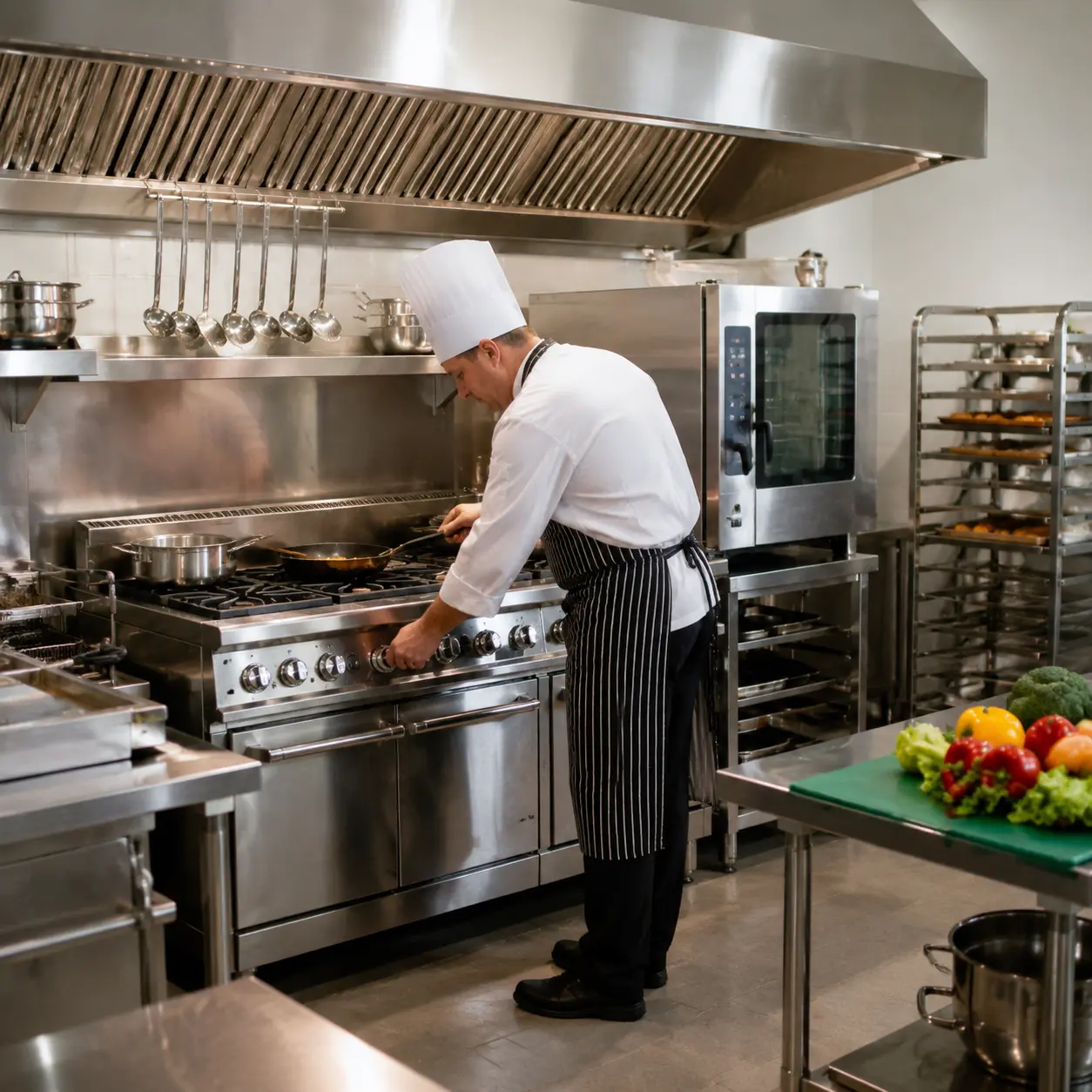
What Is Commercial Kitchen Equipment?
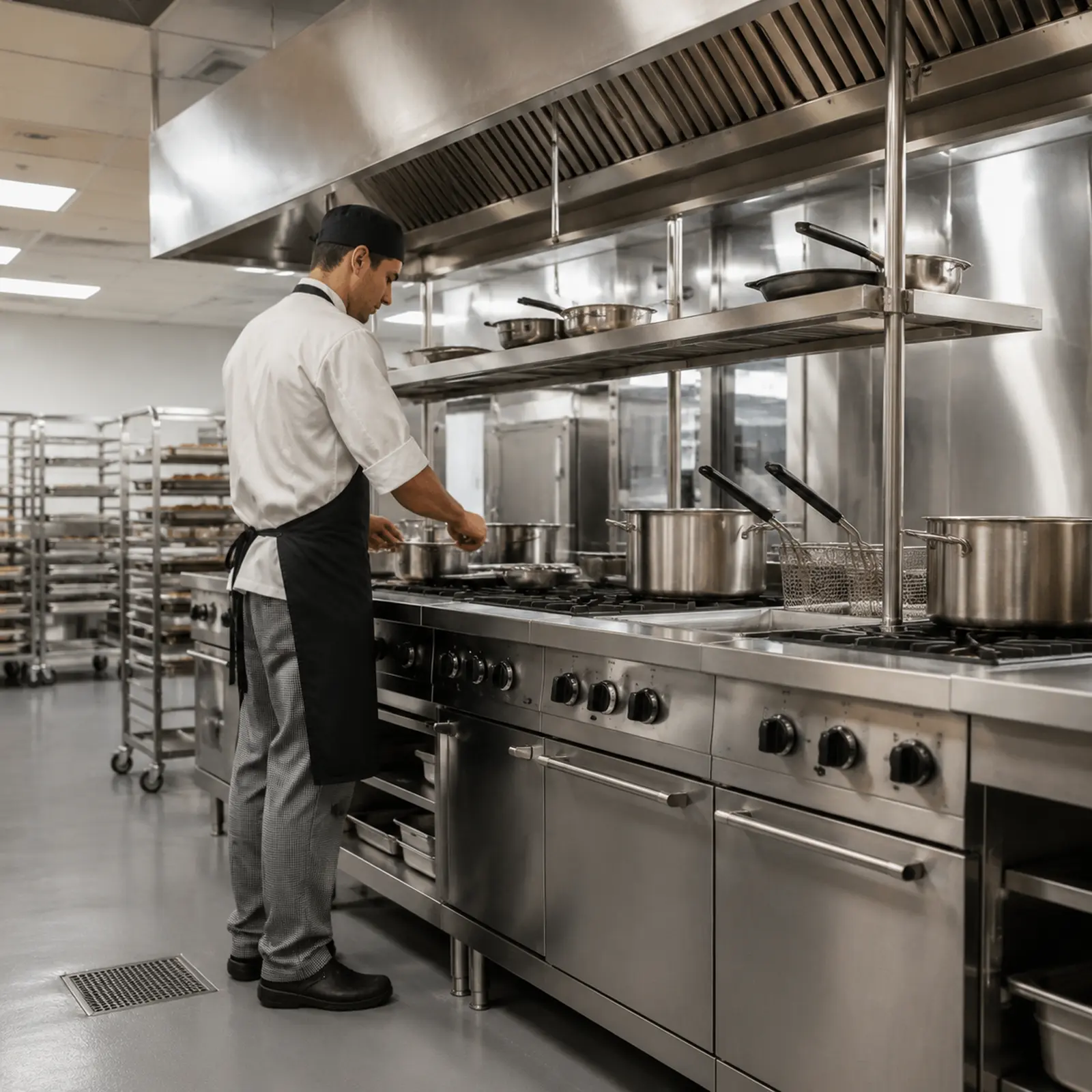
Commercial kitchen equipment is the powered, temperature-controlled, ventilated, fabricated, or specialized equipment used to prepare, cook, hold, refrigerate, wash, and serve food in a professional foodservice operation. It includes equipment such as ovens, fryers, ranges, refrigeration units, preparation machines, stainless-steel workstations, food warmers, and selected accessories. Unlike residential appliances, commercial equipment is specified around menu requirements, production volume, working hours, sanitation procedures, local utilities, and service conditions.
For a foodservice equipment importer or distributor, the term is a purchasing category rather than a single product class. The correct selection depends on what the kitchen must produce, how quickly it must produce it, where the equipment will operate, and how it will be installed and maintained. A complete quotation should therefore describe more than a model name and unit price.
Definition and Boundaries
Commercial kitchen equipment generally serves one or more operational functions:
- Preparation: cutting, mixing, kneading, blending, portioning, and assembling ingredients.
- Cooking: applying heat through convection, conduction, radiation, hot oil, steam, or a combination of methods.
- Holding: maintaining prepared food at an appropriate serving condition for a defined period.
- Refrigeration and freezing: slowing microbial growth, protecting ingredients, and managing production schedules.
- Cleaning and sanitation: washing utensils, cookware, equipment parts, and food-contact items.
- Ventilation and support: removing heat, smoke, grease, and moisture while supporting safe kitchen operation.
The category does not automatically include every item found in a restaurant. Disposable packaging, tableware, ingredients, point-of-sale hardware, and general building services are separate purchasing areas. A stainless-steel table may be commercial kitchen equipment when it is designed for food preparation or equipment support, but it is not a cooking appliance. Likewise, a household microwave or refrigerator may perform a similar function but may not meet the expected duty cycle, dimensions, cleaning requirements, or electrical configuration of a professional kitchen.
Commercial equipment is also not a substitute for kitchen design. A fryer, oven, or refrigerator must fit the available floor plan, extraction system, doorways, drainage, electrical supply, and workflow. Importers should evaluate the product together with installation requirements and after-sales support.
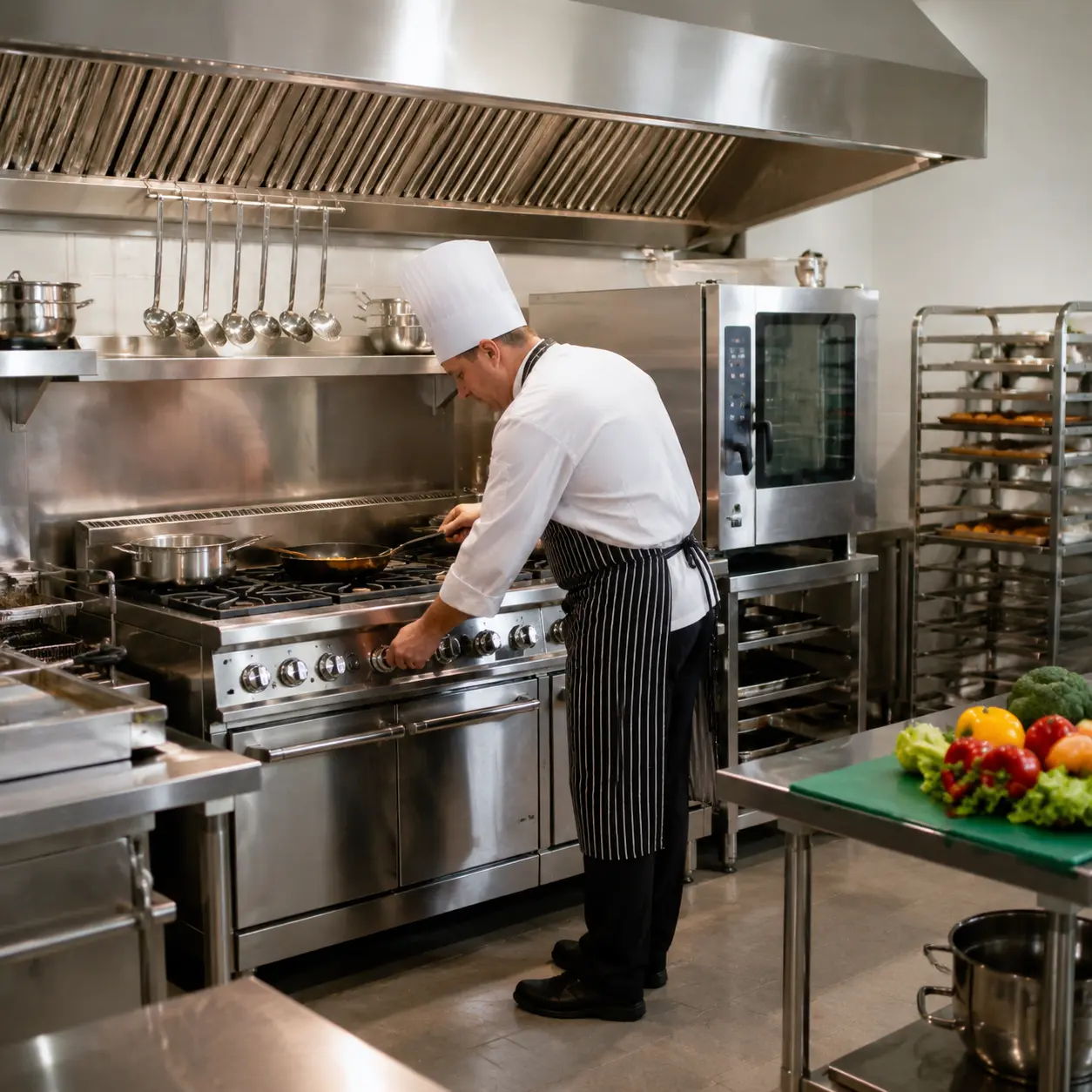
Commercial kitchen equipment for foodservice buyers
How Commercial Kitchen Equipment Works
Most equipment can be understood as a system that converts a utility or manual input into a controlled foodservice result. The input may be electricity, gas, water, refrigeration power, compressed air, or operator labor. The output may be a cooked product, a chilled ingredient, a prepared component, or a cleaner work area.
For example, a commercial oven transfers heat to food through heated air, heated surfaces, steam, or combinations of these methods. The buyer is not purchasing heat alone; the buyer is purchasing a repeatable cooking process. Important questions include how much product fits in the chamber, how evenly heat is distributed, how quickly the unit recovers after loading, and whether the controls suit the intended operators.
Refrigeration equipment removes heat from an insulated cabinet or compartment and releases that heat through a refrigeration system. Its practical performance depends on cabinet volume, ambient conditions, door-opening frequency, product loading, airflow, control settings, and maintenance. A stated capacity should therefore be read alongside usable internal dimensions, temperature range, electrical data, and test conditions.
Preparation equipment uses motors, blades, rollers, bowls, belts, or other mechanical components to change ingredients. A mixer, for instance, may be described by bowl volume or motor power, but those figures do not alone define practical output. Ingredient type, batch size, mixing time, attachment, operator method, and duty cycle also affect production.
This operating view helps buyers avoid comparing unlike claims. “Capacity” may mean chamber volume, bowl volume, storage volume, maximum batch weight, number of trays, or recommended output per hour. A quotation should state the meaning of the term and the conditions behind it.
Main Types of Commercial Kitchen Equipment
Baking and Cooking Equipment
This group includes ovens, baking ovens, proofing equipment, ranges, griddles, fryers, hot plates, and other cooking systems. Selection should begin with the menu: bread, pastry, pizza, fried food, grilled items, burgers, prepared meals, or high-volume batch cooking each impose different requirements. Review chamber dimensions, tray or rack format, temperature controls, heating method, recovery behavior, ventilation needs, and utility connection.
Refrigeration Equipment
Refrigeration includes upright cabinets, undercounter units, preparation counters, display refrigerators, freezers, and other cold-storage formats. Key considerations are net storage volume, shelf arrangement, temperature control, door configuration, insulation, condenser access, defrost method, ambient operating conditions, and delivery constraints. Buyers should request both external dimensions and usable internal dimensions.
Preparation and Snack-Shop Equipment
Preparation equipment may include mixers, slicers, cutters, presses, food processors, and machines designed for a defined snack or quick-service workflow. Hamburger-shop equipment often centers on griddles, fryers, refrigerated preparation stations, bun or food warming, and compact storage. The equipment should be assessed as a line: preparation speed must match cooking speed, holding time, order flow, and available labor.
Stainless-Steel Fabrication and Kitchen Support
Sinks, worktables, shelving, cabinets, racks, splashbacks, trolleys, and other fabricated items support hygiene and movement through the kitchen. Specification details include material grade, sheet thickness, dimensions, load expectations, adjustable features, welded or assembled construction, edges, legs, castors, drainage, and packing method.
Accessories and Utility-Support Items
Accessories can include trays, baskets, shelves, pans, attachments, replacement components, and installation-related items. They are easy to omit from a quotation, yet they may be necessary for the equipment to operate as intended. Ask whether accessories are included, optional, compatible with the quoted model, or supplied separately.
GZYF Metal describes its product range as covering baking equipment, hamburger-shop equipment, refrigeration equipment, snack equipment, other kitchen equipment, and accessories. Its website also describes product development, design, sheet-metal processing, laser cutting, bending, laser welding, and equipment manufacturing capabilities. These statements describe the supplier’s stated scope; buyers should confirm the exact production capability, model configuration, and documentation for each order through the quotation process.
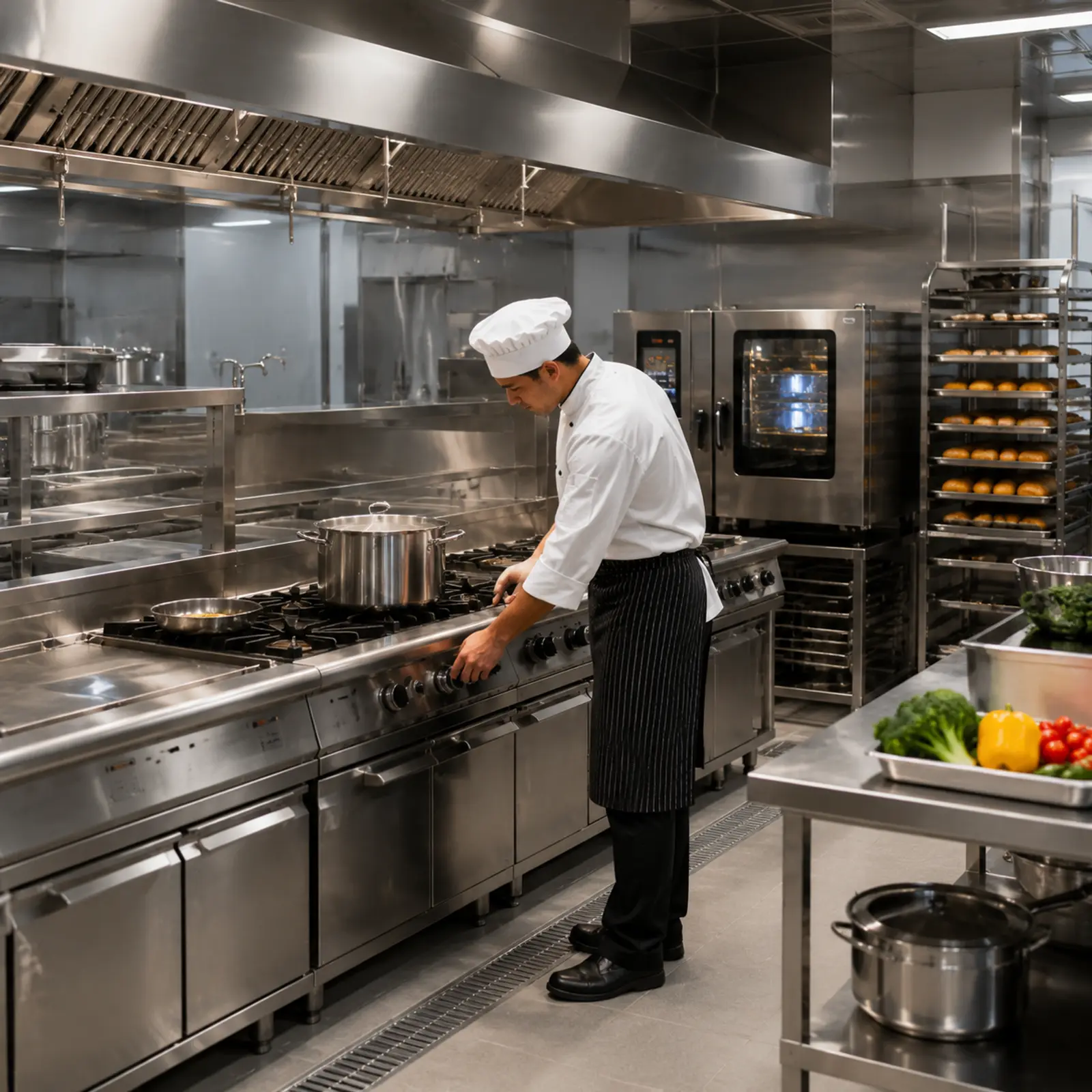
Commercial kitchen equipment for foodservice buyers
Applications in Foodservice
The same equipment category can serve different applications. A bakery may prioritize repeatable baking, proofing space, tray compatibility, and production scheduling. A burger operation may prioritize fast griddle recovery, fryer capacity, cold preparation space, and compact workflow. A hotel kitchen may need varied cooking methods, holding equipment, storage, and redundancy. A central kitchen may focus on batch consistency, throughput, sanitation, transport, and serviceability.
For importers and distributors, the application should be written into the request for quotation. State the menu, expected peak output, operating hours, batch or portion size, local voltage and frequency, fuel type, ambient conditions, available space, destination port, and required delivery terms. This gives the supplier a basis for recommending a configuration rather than sending a generic product list.
Safety and Compliance Boundaries
Safety requirements vary by destination market and equipment type. Electrical, gas, pressure, fire, ventilation, food-contact, and sanitation rules may apply separately. Do not treat a supplier’s general statement about certification as proof that a particular model is approved for your market. Request the certificate or declaration, issuing body, model coverage, test standard, validity information where applicable, and language required by local authorities.
NSF maintains a portfolio of food-equipment standards, but a buyer should verify the applicable standard and current acceptance requirements for the destination market rather than assume that one mark satisfies every jurisdiction. Certification marks and registration marks should be checked against the actual model and scope of approval. Also request wiring diagrams, user and maintenance manuals, material information for food-contact parts, and installation instructions.
Key Specification Vocabulary
- Rated capacity: the stated amount a unit is designed to hold or process; ask whether it means volume, weight, trays, portions, or output per hour.
- Working capacity: the practical recommended load, which may be lower than gross capacity.
- Duty cycle: the expected operating pattern, such as intermittent, continuous, or batch use.
- Recovery time: how quickly temperature or operating performance returns after loading or use.
- Net volume: usable internal storage space rather than the cabinet’s external or gross volume.
- Utility requirement: voltage, frequency, phase, amperage, wattage, gas pressure, fuel type, water connection, drainage, or ventilation requirement.
- Footprint: external width, depth, and height, including clearances needed for operation and service.
- Throughput: the quantity processed in a specified period under stated conditions.
- Food-contact material: the material touching ingredients or food; request the relevant material documentation when required.
- Spare-parts support: availability, lead time, part numbering, warranty procedure, and technical assistance after delivery.
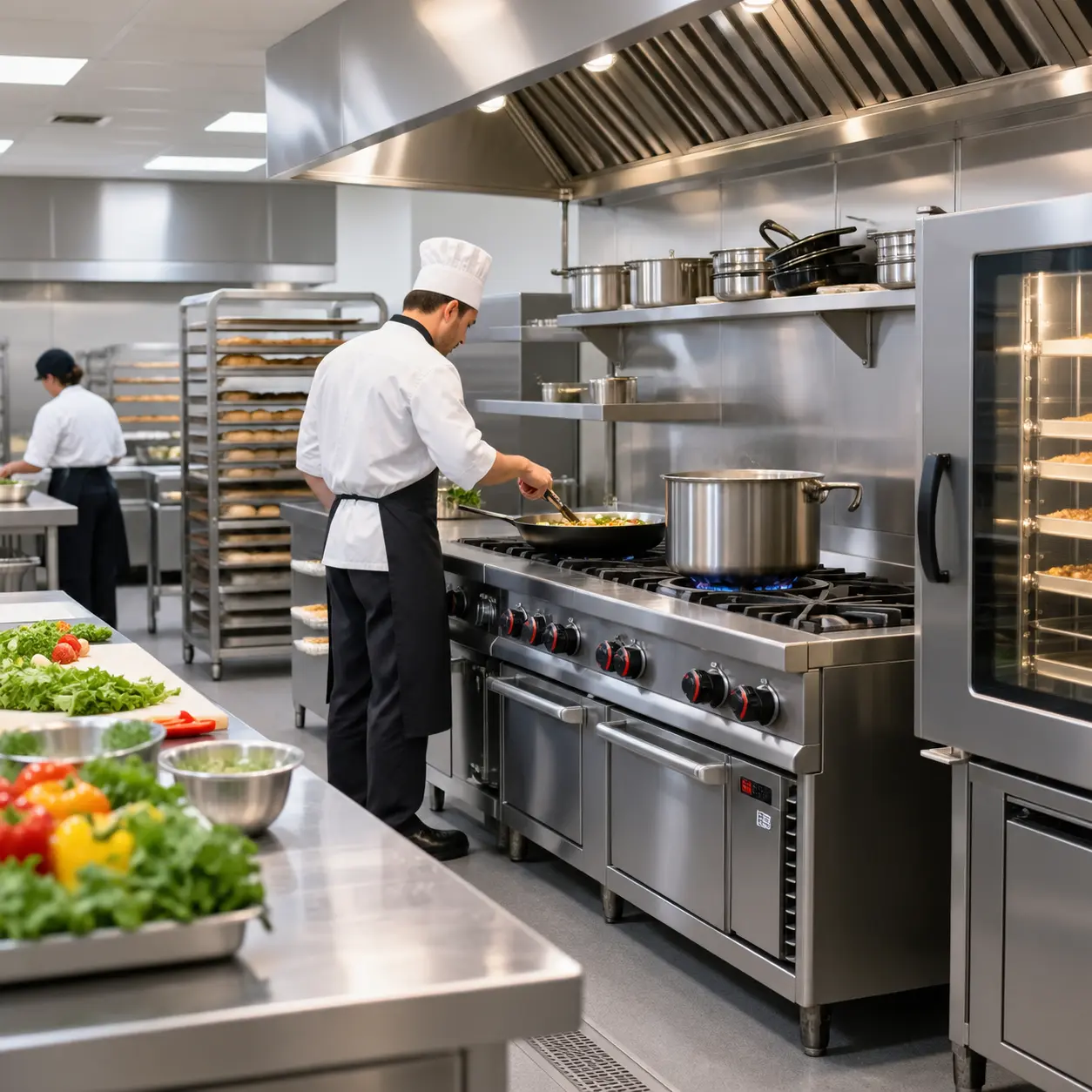
Commercial kitchen equipment for foodservice buyers
Questions to Ask Before Purchasing
Before requesting a final quotation, ask: What product and batch size is the equipment designed for? How is capacity measured? What are the tested or recommended operating conditions? Which utilities and clearances are required? What safety documents cover the exact model? Which accessories, consumables, and spare parts are included? What are the packing dimensions, shipping weight, installation requirements, warranty terms, and service process?
To compare offers accurately, request a model-specific quotation containing the technical datasheet, configuration, inclusions, exclusions, compliance documents, lead time, packing details, shipping terms, payment terms, and after-sales arrangements. Buyers can review commercial kitchen equipment products, compare commercial kitchen equipment, or request a commercial kitchen equipment quote from GZYF Metal. The company identifies itself as Guangzhou Yifeng Metal Technology Co., Ltd., located in Baiyun District, Guangzhou, Guangdong, China, and describes OEM/ODM and export-oriented service on its website. Confirm all commercial and technical details for the intended destination before placing an order.
How to Choose Commercial Kitchen Equipment for a Real Operation
The right commercial kitchen equipment is not necessarily the largest, most automated, or least expensive option. It is the equipment that matches the menu, production volume, available utilities, workspace, labor model, cleaning routine, and destination-market requirements. A disciplined selection process reduces the risk of buying a unit that cannot fit through the door, connect to the site, meet local rules, or support the intended service speed.
Start with the operating brief
Before requesting a quotation, write a short operating brief for each item. Include:
- Menu function: Identify exactly what the unit must produce, store, hold, or support.
- Expected throughput: State the required output over an hour, shift, or service period rather than relying on a vague description such as “high volume.”
- Peak demand: Explain whether the equipment will run continuously, intermittently, or under short periods of intense demand.
- Site conditions: Confirm available electrical service, gas type if applicable, water, drainage, ventilation, floor loading, door clearances, and installation space.
- Workflow: Show where ingredients enter, where finished food leaves, and how staff will clean and service the unit.
- Market and ownership model: Identify the destination country, intended brand, private-label requirements, and whether the buyer is an operator, importer, or distributor.
This brief is useful for new store openings, menu expansion, replacement of unreliable equipment, distributor catalog development, and private-label programs. Buyers can begin by reviewing commercial kitchen equipment products and then narrowing the request to a documented use case.
What Should Be in a Commercial Kitchen Equipment Quote?
A product name and headline price are not enough for a serious procurement decision. Ask the supplier to identify the exact model or configuration and separate included items from optional items. The quotation should address, where applicable:
- Equipment dimensions, net weight, materials, finish, and access clearances.
- Electrical information, including voltage, phase, frequency, connection method, and rated power where relevant.
- Gas, water, drainage, ventilation, or other utility requirements.
- Production capacity or storage volume, expressed using a clearly defined test condition or operating basis.
- Controls, accessories, racks, trays, shelves, filters, casters, panels, and other included components.
- Packaging, loading method, shipping terms, estimated freight responsibilities, and destination delivery scope.
- Installation, commissioning, training, and whether those services are included or excluded.
- Warranty duration, coverage boundaries, response process, exclusions, and the party responsible for labor and freight.
- Recommended spare parts, consumable parts, lead times, and after-sales contact details.
For a multi-unit project, request a line-item quotation rather than one combined figure. This makes it easier to compare suppliers, identify omissions, and approve substitutions. Buyers can use the commercial kitchen equipment comparison page during internal review, then request a commercial kitchen equipment quote with the operating brief attached.
Commercial kitchen equipment for foodservice buyers
How Can a Supplier Prove the Specification?
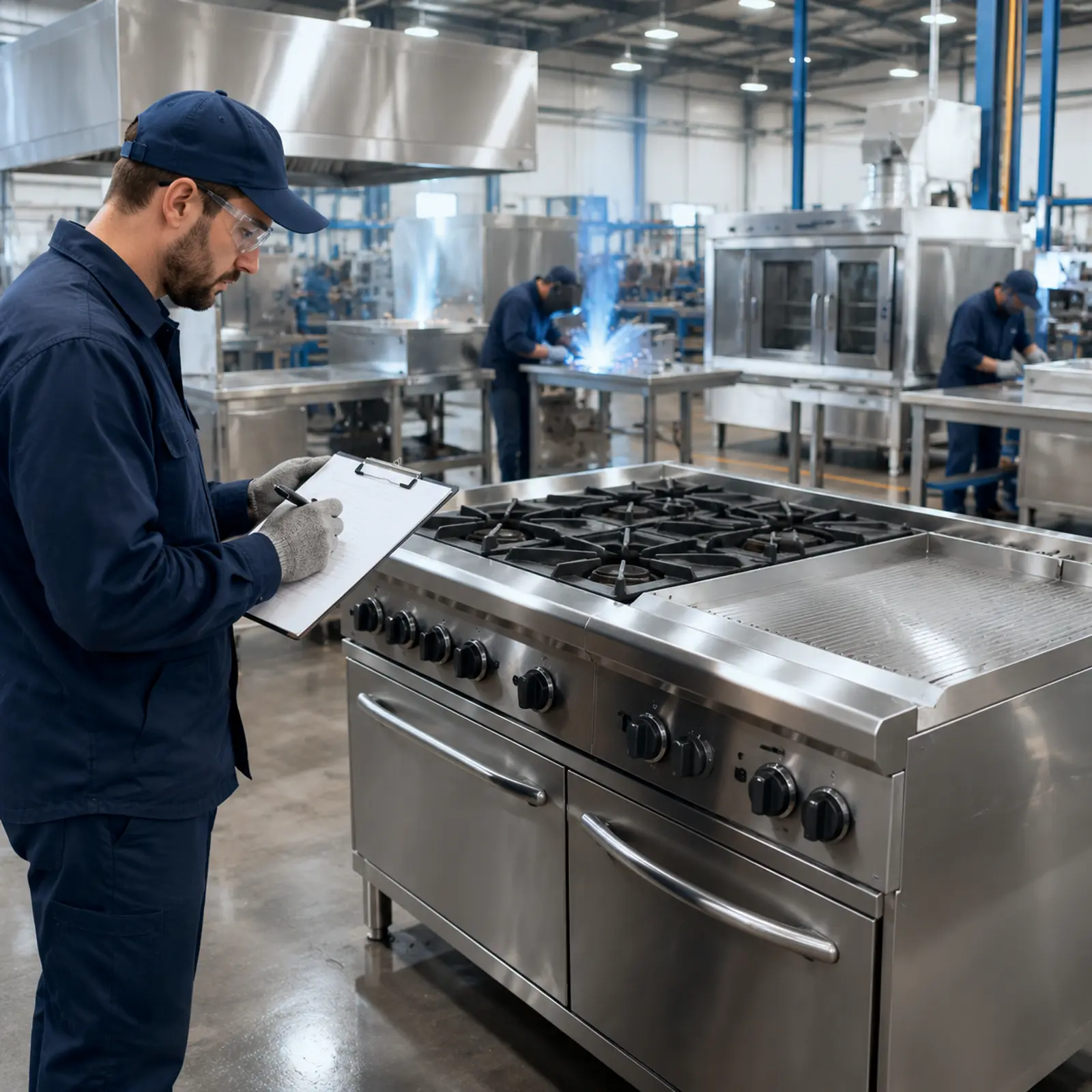
Supplier statements should be matched to documents and, where necessary, physical inspection. Ask for a controlled specification sheet showing the model number, revision date, dimensions, utilities, materials, and configuration. Request drawings or connection diagrams when site planning depends on them.
For performance-sensitive equipment, ask how the stated capacity or output was determined. The supplier should explain the test conditions, product assumptions, loading pattern, and any limits that affect performance. Do not treat a catalog description as proof of a result that has not been documented.
Also verify that the documents describe the same model being quoted. A common procurement error is comparing one supplier’s standard configuration with another supplier’s upgraded configuration. Photographs can help confirm appearance, but they do not replace specifications, drawings, manuals, or compliance documents.
GZYF Metal’s website describes capabilities including research and development, design, sheet-metal processing, laser cutting, bending, laser welding, and equipment manufacturing. Those statements provide supplier context, but a buyer should still request model-specific evidence for the equipment, configuration, and market being considered. The company identifies itself as Guangzhou Yifeng Metal Technology Co., Ltd., located in Baiyun District, Guangzhou, Guangdong, China; its manufacturing background can be reviewed alongside the technical quotation.
Which Compliance Documents Apply?
Compliance is determined by the equipment type, electrical and fuel configuration, installation environment, destination market, and authority having jurisdiction. Ask the importer, local inspector, electrical professional, gas professional, or other responsible authority which documents and marks are required before placing an order.
NSF maintains a portfolio of food-equipment standards. Buyers should consult the NSF food equipment standards portfolio and verify the current applicable requirement and model scope rather than assuming that a general reference applies to every product. A certificate, listing, declaration, test report, or other document must correspond to the quoted model and configuration.
Compliance documentation may also involve electrical safety, electromagnetic compatibility, sanitation, fire protection, pressure systems, refrigeration, energy rules, labeling, or import requirements. The precise list cannot be inferred from a product category alone. Ask for document numbers, issuing bodies, validity or revision information, and any conditions attached to the approval. If a supplier cannot provide a requested document, obtain written confirmation of what is available and have the destination-market reviewer assess the gap before purchase.
Warranty, Parts, and Long-Term Support
Warranty support should be evaluated before the purchase order, not after an installation problem. Ask who receives service requests, what information must accompany a claim, how troubleshooting is handled, and who pays for replacement parts, labor, travel, and freight. Confirm whether the warranty starts at shipment, delivery, installation, or commissioning.
Parts support deserves the same attention. Request a spare-parts list with part names, reference numbers, interchangeability notes, and expected availability. For imported equipment, clarify whether parts ship from the manufacturer, an appointed distributor, or a regional stock point. Keep manuals, wiring diagrams, exploded views, and approved replacement-part information with the equipment record.
For distributors and private-label buyers, agree on the support workflow in writing. Define escalation contacts, documentation responsibilities, branding requirements, replacement-unit procedures, and how engineering changes will be communicated. A lower initial price may not represent a lower total cost if essential parts, installation information, or technical responses are difficult to obtain.
Commercial kitchen equipment for foodservice buyers
Practical Decision Checklist
Before approval, the buyer should be able to answer “yes” to these questions:
- Does the equipment perform a clearly defined menu or workflow function?
- Are the dimensions, utilities, access route, and installation conditions confirmed?
- Does the quoted configuration match the required capacity and peak demand?
- Are included accessories, exclusions, freight, installation, and commissioning stated?
- Can the supplier provide model-specific technical and compliance documentation?
- Has the destination market’s responsible authority reviewed the applicable requirements?
- Are warranty terms, service contacts, spare parts, and response procedures documented?
- Has the team compared total ownership considerations rather than price alone?
For multiple candidates, save shortlisted products for later review using save equipment for later review, or use review selected equipment to organize an inquiry. Buyers can also review the GZYF Metal equipment portfolio before sending a finalized specification request.
Frequently Asked Questions
Is commercial kitchen equipment only the cooking machinery?
No. It includes equipment supporting preparation, cooking, holding, refrigeration, cleaning, ventilation, storage, and kitchen infrastructure. The exact scope depends on the project and procurement specification.
Can a supplier’s catalog confirm that equipment is approved in my country?
Not by itself. Approval depends on the model, configuration, destination market, and applicable authority. Request the relevant documents and have them reviewed locally before ordering.
What is the most important information to send with an inquiry?
Send the menu function, required throughput, utilities, dimensions, destination, compliance needs, documentation requirements, delivery point, installation expectations, warranty expectations, and spare-parts requirements.
Should replacement equipment match the old model?
Not automatically. Compare the old unit’s actual failure points, output, utilities, footprint, service history, and parts availability with the proposed replacement. A different configuration may fit the operation better, but it must be validated against the site and workflow.
Buyer Action
Prepare one documented equipment brief per application, request a model-specific quotation, and resolve compliance, installation, warranty, and parts questions before approving the order. When the requirements are ready, contact the supplier through request a commercial kitchen equipment quote or review GZYF Metal commercial kitchen equipment. Existing customers can access your GZYF Metal account to manage related inquiries.
References
- NSF Food Equipment Standards — standards portfolio reference; verify the current applicable requirement and model scope.
- Guangzhou Yifeng Metal manufacturing background — supplier-context information attributed to GZYF Metal.
- GZYF Metal equipment portfolio — supplier product-context reference.