 (+035) 527-1710-70
 NEWSLETTER



What Is Commercial Kitchen Equipment?
Commercial kitchen equipment is the durable, service-oriented machinery, fixtures, and accessories used to receive, store, prepare, cook, hold, display, clean, and serve food in professional foodservice operations. It includes equipment such as ovens, fryers, griddles, mixers, refrigerators, freezers, preparation tables, sinks, shelving, and specialized snack or bakery machines. Unlike household appliances, commercial equipment is selected around menu requirements, production volume, operating conditions, utilities, food-safety procedures, local regulations, installation constraints, and after-sales support.
For an importer or distributor, the product is more than a machine. It is a specification package that must include dimensions, capacity definitions, electrical or gas requirements, materials, documentation, packing details, warranty terms, spare-parts information, and a quotation that clearly states what is included.
Browse commercial kitchen equipment products when comparing equipment categories, or compare commercial kitchen equipment against the requirements of a specific market.
Definition and Boundaries
Commercial kitchen equipment supports repeated production in restaurants, bakeries, cafés, hotels, catering operations, institutional kitchens, convenience stores, food trucks, and other professional settings. Some items process food directly, while others support workflow, hygiene, storage, or service. A complete kitchen typically combines several equipment groups rather than relying on one multifunction machine.
Commercial kitchen equipment is not the same as general construction or building infrastructure. Flooring, walls, ceilings, plumbing distribution, ventilation ductwork, fire-suppression infrastructure, and electrical service may be necessary for a kitchen, but they are not usually described as the equipment itself. It is also not the same as smallwares, disposable packaging, or ordinary office appliances, although utensils, trays, containers, and accessories may be purchased alongside equipment.
The boundary can vary by project. A stainless-steel worktable, sink, exhaust hood, or shelving unit may be treated as kitchen equipment in a distributor’s catalog even though it has no motor or heating element. The practical question is whether the item has a defined role in the foodservice workflow and whether its construction, dimensions, utilities, and cleaning requirements are suitable for professional use.
How Commercial Kitchen Equipment Works
Most equipment converts an input into a controlled foodservice process. The input may be electricity, gas, water, refrigerant, manual labor, or a combination of these. The machine then applies heat, cold, pressure, rotation, airflow, filtration, cutting action, or storage control to produce a repeatable result.
A convection oven, for example, uses a heating system to raise the chamber temperature and a fan to circulate air. The relevant result is not simply the heater’s rated power; it also depends on chamber size, airflow, insulation, control accuracy, loading pattern, and the food being cooked. A fryer transfers heat through oil, while a refrigerator removes heat from an insulated cabinet and releases it through a refrigeration system. A mixer uses a motor, transmission, and attachment to apply mechanical energy to dough, batter, sauce, or another product.
This operating principle explains why headline capacity claims need context. “Capacity” may mean the internal volume, the number of trays, the recommended batch size, the maximum load, or an output rate under specified conditions. Buyers should ask the supplier to define the measurement, test conditions, cycle time, product assumptions, and acceptable operating limits.
Equipment performance also depends on the surrounding system. A cooking appliance may require ventilation and make-up air. A refrigeration unit may need adequate clearance and a suitable ambient temperature. A water-connected machine may require specified pressure, drainage, filtration, or treatment. Before purchasing, match the equipment to the destination market’s utilities and installation conditions rather than evaluating the catalog description alone.
Main Types of Commercial Kitchen Equipment
Cooking Equipment
Cooking equipment applies controlled heat to raw or partially prepared food. Common examples include ovens, ranges, induction units, griddles, grills, fryers, steamers, kettles, and cooking lines. Selection depends on the menu, batch size, cooking method, recovery time, temperature range, controls, ventilation needs, and available fuel or electrical supply.
Baking and Preparation Equipment
Baking operations may use deck ovens, convection ovens, proofers, dough mixers, planetary mixers, sheeters, dividers, and related accessories. Preparation equipment can include slicers, cutters, food processors, blenders, vegetable processors, and worktables. The buyer should confirm product-contact materials, attachment options, cleaning access, batch definitions, and whether the machine is designed for the intended dough, batter, or ingredient.
For bakery and food-preparation projects, review the GZYF Metal equipment portfolio as part of a broader supplier comparison.
Refrigeration Equipment
Refrigeration equipment protects ingredients and prepared food by maintaining a controlled low-temperature environment. It includes reach-in refrigerators, freezers, undercounter units, refrigerated counters, prep tables, display cases, and cold-storage systems. Important specifications include net usable volume, temperature range, shelf arrangement, refrigerant information, climate or ambient operating conditions, defrost method, door configuration, insulation, and power requirements.
Foodservice and Snack Equipment
Snack shops, hamburger restaurants, cafés, and takeaway operations often require focused equipment such as burger presses, hot dog machines, display warmers, popcorn machines, waffle makers, beverage equipment, and compact cooking appliances. The correct choice depends on the service model, peak demand, counter space, product range, cleaning routine, and expected operator skill.
Storage, Work, and Sanitation Equipment
Storage and support equipment includes stainless-steel tables, sinks, racks, shelving, cabinets, ingredient bins, hand-washing stations, and dishwashing equipment. These items influence movement, separation of raw and cooked food, cleaning procedures, and available storage. Confirm dimensions, load ratings, material grade or finish, adjustable features, drainage, splash protection, and assembly requirements.
Accessories and Replacement Items
Accessories may include trays, baskets, racks, pans, blades, attachments, filters, seals, casters, and control components. They affect the equipment’s practical usefulness and service life. A distributor should identify consumable and replaceable parts before placing an order and request part numbers, lead times, recommended stock levels, and compatibility details.
Applications and Workflow Fit
Commercial kitchen equipment should be selected from the workflow outward. A bakery may prioritize mixing, proofing, baking, cooling, and display. A burger operation may prioritize refrigerated preparation, griddling, frying, holding, assembly, and rapid service. A hotel or institutional kitchen may need high-volume batch cooking, cold storage, warewashing, and production scheduling.
Start with the menu and forecast demand by daypart. Define the number of portions, batch size, peak-hour output, holding time, and expected operating hours. Then map the available space, doorways, floor loading, ventilation, water, drainage, voltage, frequency, phase, fuel, and local service capability. This process helps prevent the common mistake of choosing an attractive machine that cannot meet the actual throughput or installation conditions.
When evaluating a supplier such as Guangzhou Yifeng Metal Technology Co., Ltd., ask which product category and configuration match the workflow. The company describes itself as a commercial kitchen equipment manufacturer and exporter with product development, manufacturing, OEM/ODM support, and export-oriented service. Its website describes R&D, design, sheet-metal processing, laser cutting, bending, laser welding, and equipment manufacturing capabilities. These descriptions indicate areas to discuss with the supplier; they do not replace product-level verification.
For a broader review, see the GZYF Metal commercial kitchen equipment range and the pages for commercial kitchen equipment products.
Key Specification Vocabulary
- Rated capacity: The supplier’s stated load, volume, tray count, or output. Ask how it is measured and whether it is a maximum, recommended, or tested value.
- Throughput: The quantity processed over a period, such as portions per hour or batches per cycle. Confirm product, timing, and operating assumptions.
- Working volume: The usable internal space, which may be less than the gross cabinet or chamber volume.
- Recovery time: The time needed for an appliance to return to its operating condition after loading or use. This can affect peak service.
- Utility requirement: The required voltage, frequency, phase, amperage, wattage, gas type, pressure, water supply, drain, ventilation, or refrigeration clearance.
- Product-contact surface: Any surface that touches food. Request material information, finish details, and cleaning instructions.
- Operating range: The specified temperature, pressure, speed, humidity, or environmental range in which the equipment is intended to operate.
- Footprint and service clearance: The equipment’s external dimensions plus the space needed for loading, cleaning, ventilation, maintenance, and safe access.
- Incoterm and shipment basis: The commercial terms that identify responsibilities for transport, export handling, insurance, delivery, and import clearance. A quotation should state the agreed term and named place.
- Documentation package: The manuals, wiring diagrams, parts lists, declarations, test records, labeling information, and market-specific safety documents required for review, installation, and service.
Do not treat a generic price list as a complete quotation. Request a model number, configuration, quantity, unit price, tooling or customization cost, packing method, carton or crate dimensions, gross weight, lead time, payment terms, warranty coverage, spare-parts policy, installation scope, and freight assumptions. Ask the supplier to identify exclusions, including local delivery, duties, taxes, electrical conversion, ventilation, commissioning, and training.
Certification and compliance requirements depend on the destination market and equipment type. Review the applicable authority’s requirements and verify the scope, model coverage, validity, and labeling of any claimed mark or certificate. The NSF food equipment standards portfolio can be used as a standards reference, while certification-mark guidance should be checked against the relevant market and approval body. A supplier’s general statement about certificates is not evidence that every quoted configuration is covered.
Use the specification vocabulary above to turn a product inquiry into a comparable sourcing document. Then request a commercial kitchen equipment quote with the menu, target output, destination, utilities, dimensions, documents, service expectations, and delivery terms clearly stated.

Commercial kitchen equipment for foodservice buyers

Commercial kitchen equipment for foodservice buyers
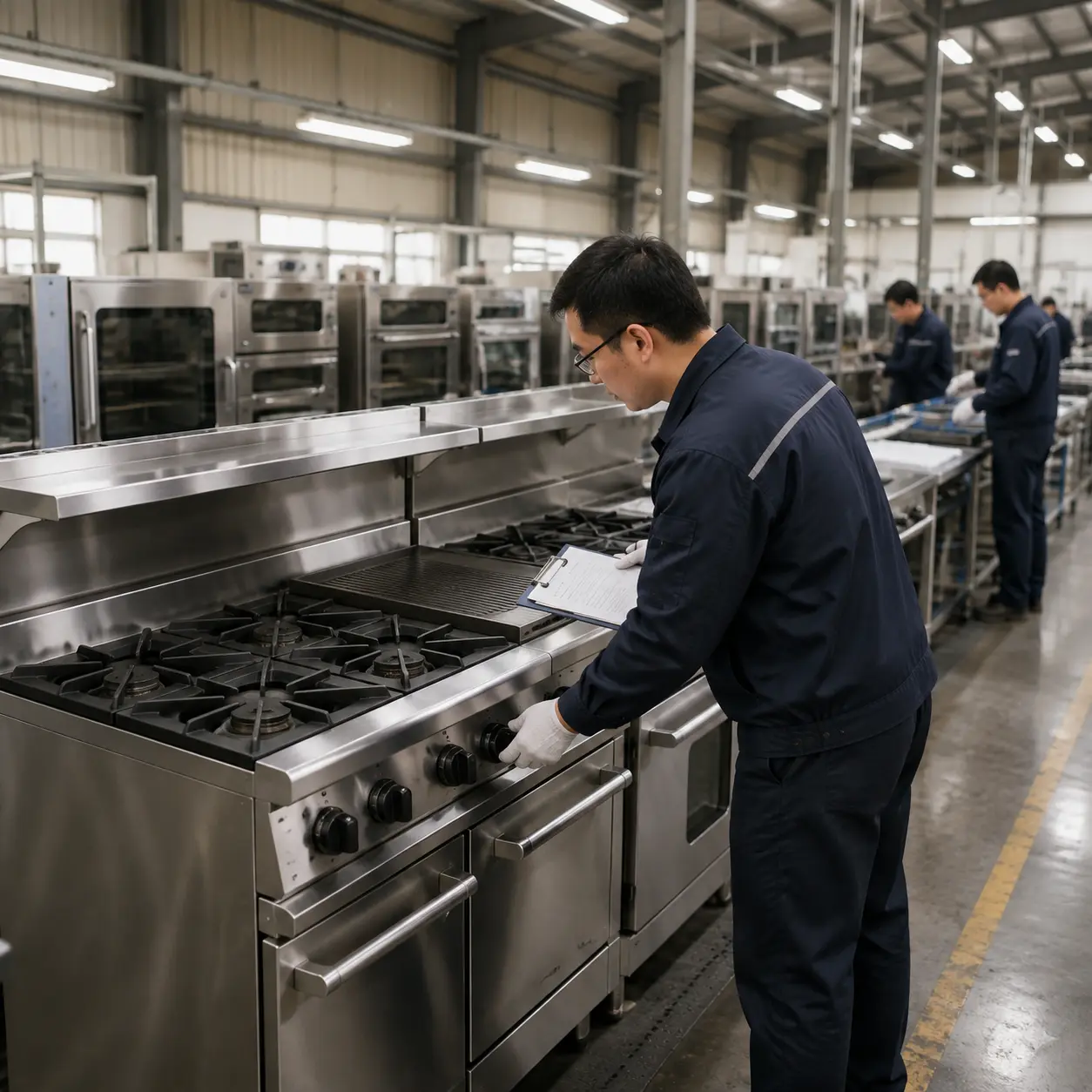
Commercial kitchen equipment for foodservice buyers
How to Choose Commercial Kitchen Equipment for a Real Operation
The right commercial kitchen equipment is determined by the menu, production volume, available utilities, workflow, labor model, and destination-market requirements. A bakery may prioritize temperature consistency, rack compatibility, and cleaning access. A burger operation may need rapid cooking, grease management, refrigeration, and a layout that supports a short order-to-service path. A hotel or institutional kitchen may place greater emphasis on batch production, redundancy, serviceability, and standardized replacement parts.
For an importer or distributor, the decision is also commercial. Equipment must be easy to specify, quote, install, document, support, and resell. A low purchase price does not compensate for unclear capacity definitions, missing utility information, difficult-to-source parts, or an unsuitable electrical configuration.
| Buying situation | Questions to resolve before selection |
|---|---|
| New store opening | Does the equipment fit the menu, floor plan, utilities, ventilation plan, and opening schedule? |
| Menu expansion | Can the unit add production capacity without creating bottlenecks in preparation, holding, or cleaning? |
| Replacement purchase | What caused the previous failure, and does the proposed design address service access, duty cycle, or environmental conditions? |
| Distributor catalog expansion | Are specifications, manuals, images, packaging details, and spare-parts policies complete enough for resale? |
| Private-label development | Which design features, labels, packaging elements, documents, and inspection steps must be agreed before production? |
Specification and Quotation Checklist
A professional quotation should define more than the product name and a unit price. Ask the supplier to identify the model, dimensions, net and gross weight, materials where relevant, usable capacity, duty or operating limitations, and included accessories. If a supplier uses terms such as capacity, output, or production per hour, ask how the figure is measured and which operating conditions apply.
Utility information should be equally precise. Confirm voltage, phase, frequency, rated power or fuel requirement, plug or connection configuration, water inlet and drain requirements, ventilation needs, and any installation clearances. Electrical compatibility must be checked by a qualified installer in the destination market; an adapter is not a substitute for a correctly rated installation.
The quotation should also state what is included and excluded. Clarify whether the price includes trays, racks, shelves, baskets, hoses, filters, casters, controllers, installation hardware, manuals, labels, and export packaging. Confirm the trade term, loading port, carton or crate dimensions, shipping weight, lead time, minimum order quantity, payment terms, and whether inspection is available before shipment.
For a distributor, request a document package that can be transferred to the customer. Depending on the market and equipment type, this may include an operating manual, installation instructions, wiring diagram, parts list, maintenance schedule, cleaning instructions, declaration or test documentation, and product identification label. The exact legal requirements should be confirmed with the importer of record, local authority, and qualified compliance professional.
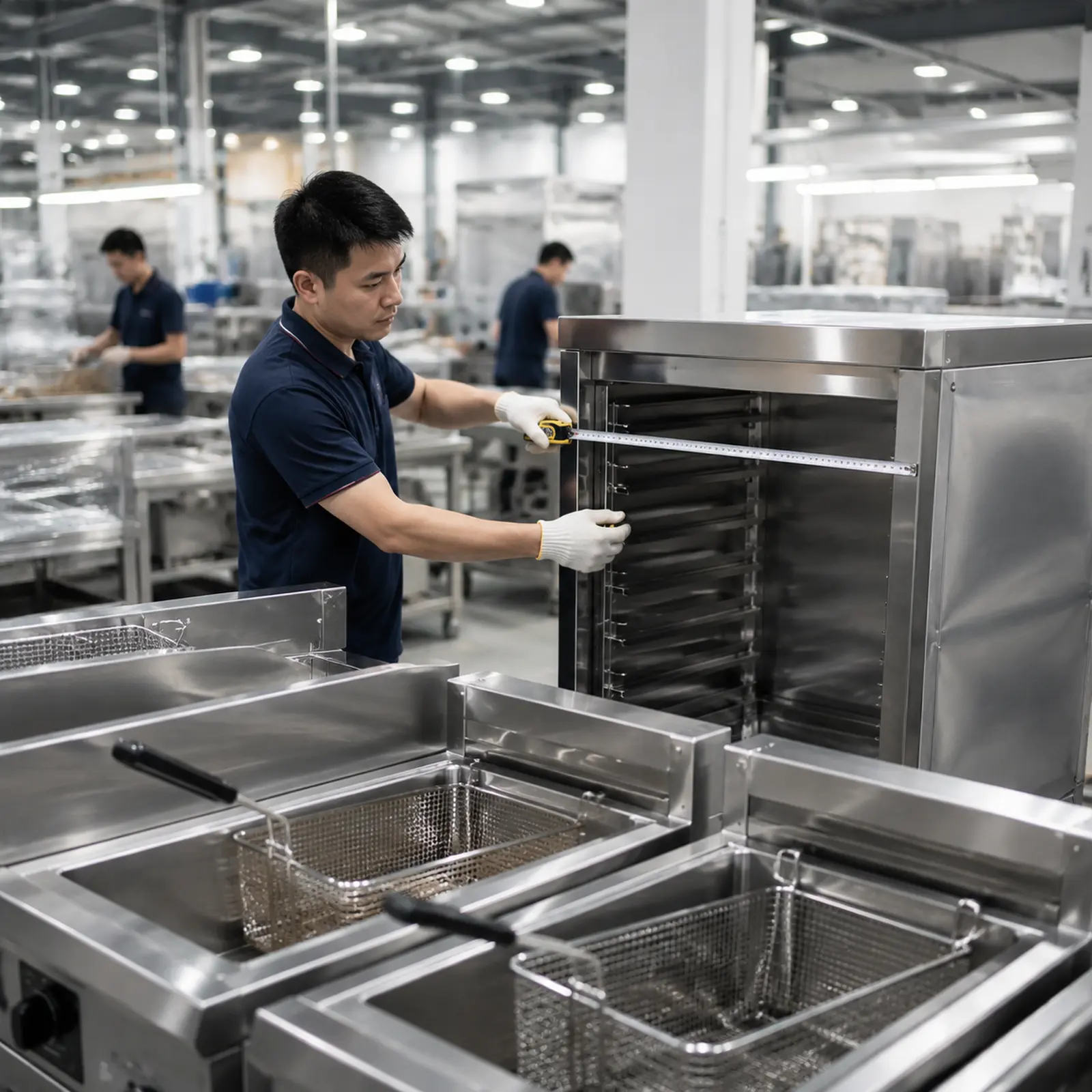
Commercial kitchen equipment for foodservice buyers
Compliance, Safety, and Evidence Boundaries
Commercial kitchen equipment interacts with food, heat, electricity, gas, water, grease, and moving components. Selection therefore involves both food-safety and workplace-safety considerations. Buyers should verify cleanability, access to food-contact surfaces, drainage, surface condition, guarding, thermal protection, grounding, emergency controls where applicable, and safe maintenance access.
Do not treat a supplier statement such as “food grade,” “approved,” or “certified” as sufficient evidence. Ask which exact model is covered, which organization issued the document, what standard or regulation applies, whether the document is current, and whether the certification mark may legally be used in the destination market. A standard reference is not automatically a certification.
The NSF food equipment standards portfolio is a useful starting point for identifying standards related to food equipment, but buyers should verify the current applicable standard and scope directly through the relevant standards body or market authority. Requirements can differ by country, equipment category, installation type, and whether the unit contacts food, handles potable water, uses gas, or incorporates electrical controls.
Certification is also separate from installation approval. A unit may have product documentation yet still require local review of ventilation, gas piping, electrical work, fire protection, drainage, or building-code compliance. The importer and site contractor remain responsible for confirming those obligations before shipment and installation.
Warranty, Parts, and Service Questions
Warranty language should identify the coverage period, start date, covered components, exclusions, labor responsibility, freight responsibility, claim evidence, and remedy process. Ask whether replacement parts are supplied free of charge, sold at a defined price, or reimbursed after approval. Also ask how a claim is diagnosed when the customer is in another country.
Parts support should be practical rather than generic. Request an exploded parts diagram or parts list where available, component names, part numbers, recommended consumables, and a procedure for ordering replacements. Confirm whether electrical components, switches, heating elements, thermostats, seals, casters, filters, and other service items are standard or proprietary. A distributor should know which parts to stock and which can be ordered against a model and serial number.
Before approving a supplier, ask for evidence that connects the quoted specification to the shipped product. Useful evidence may include a signed specification sheet, production drawing, approved sample, inspection report, serial-number record, packaging photographs, or a pre-shipment checklist. The evidence should identify the model and revision so that a later production change does not go unnoticed.
Using a Manufacturer as a Supplier-Evaluation Example
Guangzhou Yifeng Metal Technology Co., Ltd. is presented in its company context as a commercial kitchen equipment manufacturer and exporter offering product development, manufacturing, and OEM/ODM support. Its website describes capabilities including research and development, design, sheet-metal processing, laser cutting, bending, laser welding, and equipment manufacturing. These statements can help an importer frame an initial supplier discussion, but they do not by themselves prove a particular product’s capacity, certification, reliability, or market eligibility.
When evaluating Guangzhou Yifeng Metal manufacturing background, ask for model-specific evidence and compare the answer with the requirements of the intended application. Buyers can review the GZYF Metal equipment portfolio, commercial kitchen equipment products, and compare commercial kitchen equipment before requesting a formal quotation.
Frequently Asked Questions
What is the most important specification?
There is no single universal specification. Menu fit, usable capacity, utility compatibility, duty cycle, cleanability, installation space, and service support should be assessed together.
Can a supplier prove the specification?
Request a model-specific specification sheet and supporting evidence such as drawings, inspection records, an approved sample, or pre-shipment verification. Do not rely only on catalog wording or an unqualified capacity claim.
Which documents apply in my market?
That depends on the equipment, country, installation, and authority having jurisdiction. Confirm requirements for electrical, gas, food-contact materials, sanitation, emissions, ventilation, and labeling before placing the order.
What should be included in the quote?
The quote should define the model, configuration, utilities, dimensions, included accessories, packaging, shipping terms, lead time, warranty, spare-parts process, documentation, and inspection arrangements.
How should warranty and parts support be evaluated?
Ask who pays for replacement parts and freight, how claims are diagnosed, how long parts remain available, and whether the supplier provides model-specific manuals and parts lists.

Commercial kitchen equipment for foodservice buyers
Buyer Action: Turn the Inquiry Into a Comparable Specification
Prepare one written inquiry for every shortlisted supplier. Include the menu application, expected operating pattern, destination country, utilities, installation constraints, preferred materials or finish, required documents, packaging needs, warranty expectations, and spare-parts plan. This makes supplier responses comparable and exposes missing information early.
For a starting point, visit GZYF Metal commercial kitchen equipment, review products, and request a commercial kitchen equipment quote. You can also save equipment for later review, review selected equipment, or complete your equipment inquiry. The objective is not simply to buy a machine; it is to create a documented, installable, supportable equipment package.
References
- NSF Food Equipment Standards — standards portfolio reference for food equipment requirements.
- Restaurant Equipment Certification: Marks and Types — certification-mark background reference.
- Restaurant Equipment Certification and Registration Marks Explained — additional certification terminology reference.