 (+035) 527-1710-70
 NEWSLETTER



Commercial kitchen equipment categories are useful only when they help a foodservice buyer connect a piece of equipment to a menu, production volume, site condition, and service model. A distributor or importer evaluating a restaurant project should classify equipment by what it does, how it produces heat or cold, what utilities it requires, how much product it handles, and how operators control it. This approach makes supplier quotations easier to compare and exposes missing information before an order is placed.
The practical objective is not to select one equipment type for every kitchen. A high-volume burger operation, a bakery, a snack counter, and a full-service restaurant have different production sequences and operating constraints. The right category depends on the application and the destination market.
Classification: Start With the Production Task
The first classification is by use case. Common commercial kitchen equipment categories include baking equipment, cooking equipment, refrigeration equipment, preparation equipment, holding equipment, washing equipment, snack equipment, and accessories. Within each category, the buyer should request the exact function rather than relying on a broad product name.
- Baking equipment: ovens, dough-processing equipment, proofing equipment, and bakery accessories. Selection depends on the product recipe, batch pattern, tray or pan format, humidity requirements, and daily production schedule.
- Cooking equipment: ranges, griddles, fryers, grills, hot plates, steam equipment, and combination units. The relevant distinctions include heat recovery, cooking surface, temperature range, control method, and cleaning access.
- Refrigeration equipment: undercounter units, reach-ins, prep counters, display refrigeration, freezers, and cold-storage systems. The buyer needs usable internal volume, temperature range, door configuration, ambient operating conditions, and refrigerant information.
- Preparation equipment: mixers, slicers, processors, worktables, sinks, and smallwares. These items influence labor flow, batch consistency, sanitation, and the number of operators required.
- Snack and service equipment: equipment for burgers, fried foods, hot snacks, beverage service, and front-counter production. Compact dimensions and rapid recovery may matter more than broad menu flexibility in a limited-service site.
- Holding and support equipment: heated cabinets, pass-through units, shelving, exhaust-related items, and transport accessories. These products connect the production area to dispatch, service, and delivery workflows.
GZYF Metal’s website presents its product categories as baking equipment, hamburger shop equipment, refrigeration equipment, snack equipment, other kitchen equipment, and accessories. These categories can provide a starting point for an inquiry, but the importer should still confirm the intended application, model configuration, and available documentation for each item. The company describes product development, manufacturing, sheet-metal processing, laser cutting, bending, and laser welding capabilities; these claimed capabilities may be relevant when a project needs OEM or ODM development, subject to technical review.

Commercial kitchen equipment for foodservice buyers
Comparison Table: The Dimensions That Change a Purchase Decision
| Classification dimension | Typical alternatives | Buyer consequence | Quotation details to request |
|---|---|---|---|
| Heating method | Direct contact, convection, radiant, steam, microwave, or combination | Affects product quality, cook time, recovery behavior, cleaning, and menu flexibility | Heating description, temperature range, recovery information, and application limits |
| Fuel or power source | Electric, gas, induction, or mixed utility configuration | Determines installation requirements, operating cost assumptions, ventilation needs, and destination-market compatibility | Voltage, phase, frequency, input rating, gas type, connection size, plug, and utility drawings |
| Form factor | Countertop, undercounter, freestanding, modular, or pass-through | Controls floor space, workflow, access for service, and installation sequencing | External dimensions, clearances, net weight, packing dimensions, and installation method |
| Capacity | Batch size, tray count, chamber volume, pan size, or storage volume | Influences throughput, labor planning, queue performance, and the number of units required | Define how capacity is measured and request usable capacity, not only a marketing label |
| Controls | Manual, thermostatic, digital, programmable, or network-enabled | Changes operator training, repeatability, troubleshooting, and replacement-part requirements | Control functions, error codes, programming limits, manuals, and control-component suppliers |
| Use environment | Indoor production, front counter, mobile service, cold room, or high-humidity area | Determines enclosure, drainage, ventilation, access, and cleaning requirements | Operating environment, IP information where applicable, drainage, ventilation, and cleaning instructions |
Capacity claims require particular attention. “Large capacity,” “high output,” or a tray count does not explain how the figure was measured. Ask whether the stated capacity is gross or usable, whether it assumes a specific product, and whether the equipment can recover between batches. For refrigeration, ask for the storage volume and the temperature performance under the stated ambient conditions. For cooking equipment, ask how many portions or batches the supplier expects per hour and what assumptions support that figure. A distributor should record these answers in the quotation instead of allowing informal claims to remain undocumented.
Use-Case Routing: Match Equipment to the Operation
For a burger restaurant, route the inquiry around the production line: cold storage, preparation, griddling or grilling, frying, holding, assembly, and cleaning. Confirm whether the equipment is intended for a compact counter, a back-of-house line, or a central production kitchen. The quotation should identify cooking surface dimensions, oil or grease management where relevant, recovery expectations, electrical or gas requirements, and replacement components.
For a bakery, begin with the recipe and production schedule. A buyer should define product type, batch size, pan format, loading pattern, desired controls, and whether the site needs staged production or continuous output. Baking equipment should be assessed together with refrigeration, proofing, preparation, racks, and delivery access. A technically suitable oven may still be a poor project choice if the site cannot accommodate its utility load, clearance, ventilation, or movement path.
For snack shops and limited-service counters, prioritize workflow density and service speed. Countertop or modular equipment may conserve space, but the buyer should check operator access, cleaning time, heat discharge, noise, and queue-side safety. Confirm whether front-of-house appearance, display visibility, or customer-facing controls affect the specification.
For restaurants with a broad menu, compare flexible multi-use equipment with dedicated units. A combination unit or programmable control system may reduce the number of separate machines, while dedicated equipment can simplify training and provide predictable output for a narrow menu. The decision should account for peak demand, backup planning, staff skill, maintenance access, and the consequences of downtime.
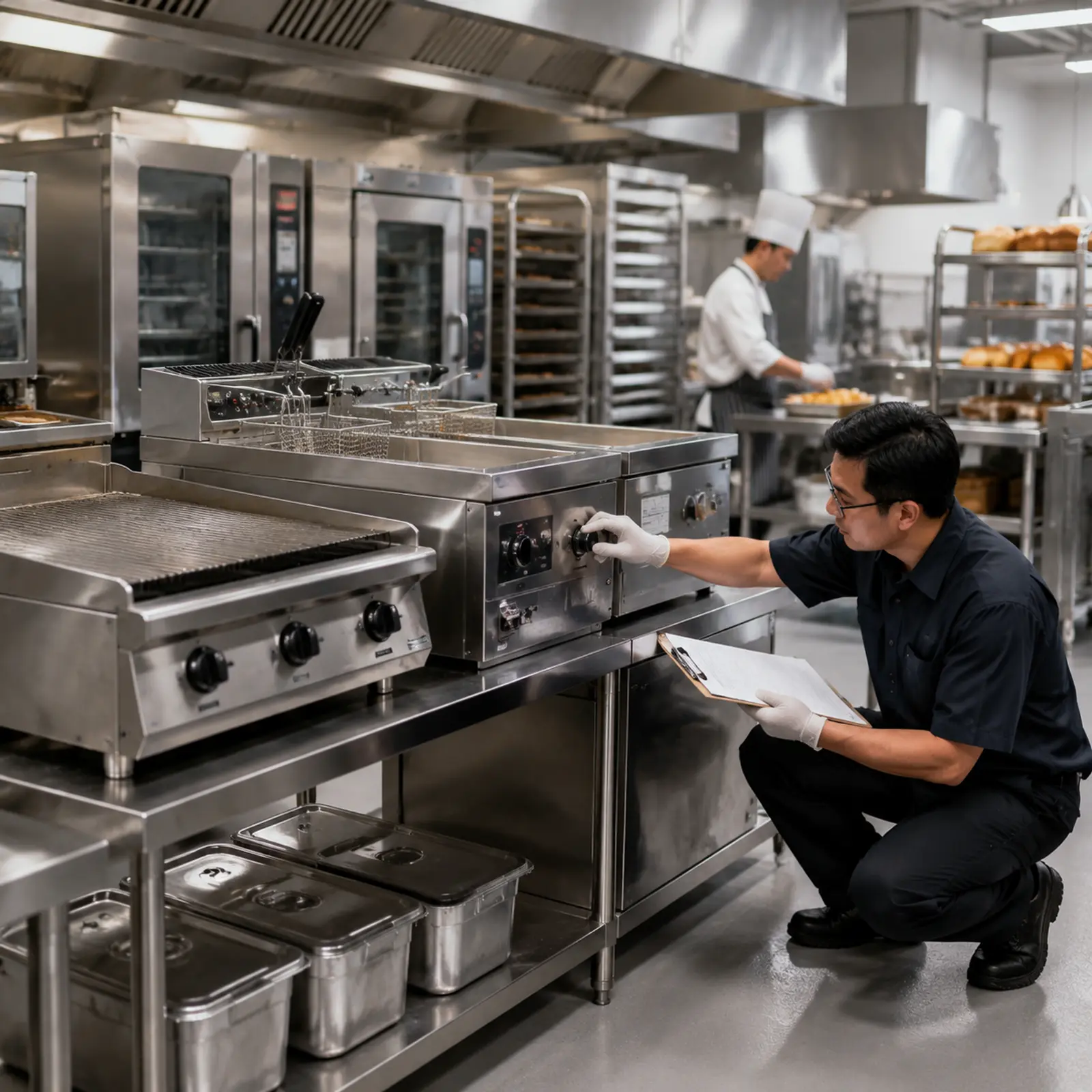
Commercial kitchen equipment for foodservice buyers
Selection Implications: Utilities, Compliance, and Service
Destination-market requirements must be confirmed before commercial terms are finalized. Request electrical data in the local format, including voltage, phase, frequency, rated input, plug or terminal arrangement, and protection requirements. For gas equipment, request fuel type, pressure, connection information, combustion documentation, and ventilation requirements. Refrigeration quotations should identify the refrigerant and provide installation, drainage, and ambient-condition requirements.
Safety documentation should be treated as part of the product specification. Depending on the destination and equipment type, the buyer may need manuals, wiring diagrams, declaration documents, test reports, material information, sanitation details, or certification records. NSF maintains a portfolio of food equipment standards, while certification marks and registration requirements can vary by equipment type and market. Buyers should verify the exact requirement with the relevant authority, importer, consultant, or testing body rather than assuming that a general mark applies to every product. Guidance from NSF’s food equipment standards portfolio and explanatory references from Kitchenall and WebstaurantStore can help frame the review, but they do not replace destination-market verification.
Service planning should be included in the first quotation request. Ask for the warranty scope, exclusions, recommended preventive maintenance, consumable parts, spare-parts list, lead times, technical support method, and troubleshooting documents. Also request packed dimensions, gross weight, shipping terms, insurance responsibility, installation scope, commissioning, and whether training is included. A low unit price can become an unsuitable project cost when freight, local adaptation, installation, or service support is omitted.
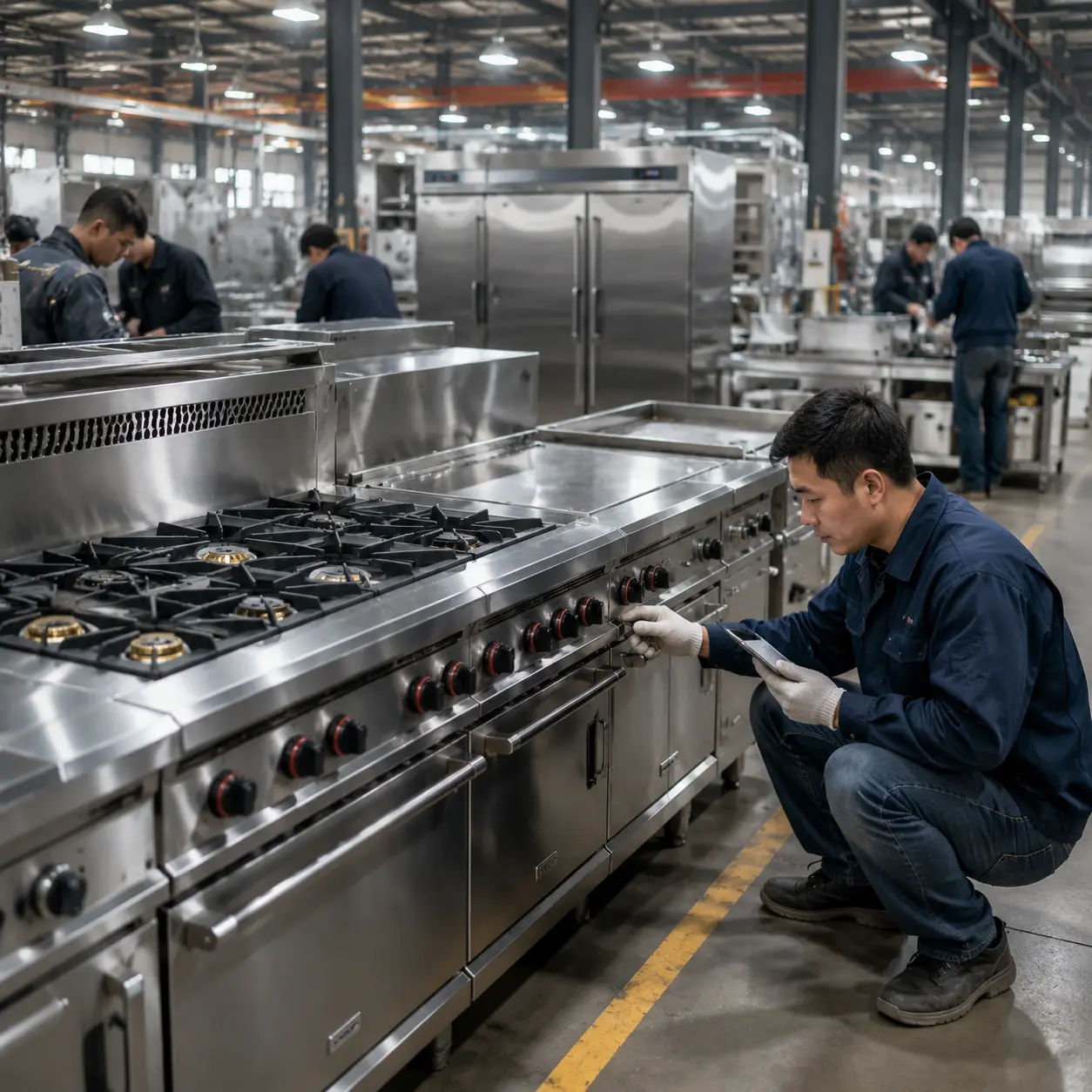
Commercial kitchen equipment for foodservice buyersFor a structured inquiry, a buyer can review commercial kitchen equipment products, use the compare commercial kitchen equipment function for shortlisted items, and prepare a consolidated request through request a commercial kitchen equipment quote. Include the menu, expected peak volume, site utilities, destination country, required documents, delivery address, installation expectations, and spare-parts requirements. This gives the supplier enough context to provide a project-specific quotation rather than a generic product list.
Route the Category to the Operating Model
Equipment categories become useful when they are connected to the way a kitchen produces, holds, and serves food. A new store opening may need a coordinated package across several categories, while a replacement project may concern one unreliable unit and its utility connection. Menu expansion, distributor catalog development, private-label work, and destination-market compliance each change the purchasing brief.
| Operating model | Category priorities | Questions that affect the purchase |
|---|---|---|
| Burger restaurant | Griddles, fryers, refrigeration, prep tables, ventilation-related equipment, and service accessories | Does the equipment support the sequence from cold storage to cooking to assembly? Are cooking surfaces, oil equipment, and holding areas sized around the expected menu and rush pattern? |
| Bakery | Ovens, mixers, proofing or holding equipment, refrigeration, worktables, and ingredient-handling accessories | Is production organized around batch size, bake schedule, cooling space, and cleaning intervals? Will the power source and installation conditions support the selected heating method? |
| Snack or limited-service counter | Compact cooking equipment, refrigeration, display or holding equipment, prep equipment, and smallwares | Can a small team operate the line without crossing clean and dirty workflows? Which functions must be dedicated, and which can be shared? |
| Broad-menu restaurant | Flexible cooking equipment supplemented by dedicated units for high-volume or specialized menu items | Does flexibility justify the additional operating complexity? Will one versatile unit create a bottleneck when several menu items are ordered at once? |
For a supplier review, category labels are only the beginning. A buyer should convert each category into a schedule of required functions, installation points, cleaning requirements, and service expectations. The commercial kitchen equipment products page can be used as a starting point for that schedule, while the compare commercial kitchen equipment workflow can help organize alternatives before a quotation is requested.

Commercial kitchen equipment for foodservice buyers
Check Utilities Before Comparing Models
Heating method and power source can change the project more than the product name suggests. Gas-fired, electric, and other powered configurations may require different supply lines, ventilation arrangements, controls, and installation approvals. A compact countertop format may conserve floor space but still need adequate electrical capacity, clearance, drainage, or heat management. A floor-standing unit may improve throughput or access but affect aisle width, delivery access, and cleaning space.
Before asking for a final price, provide the supplier with the destination country, city or market, available voltage and frequency, fuel type, plug or connection expectations, room dimensions, door and lift access, ventilation constraints, and any local installation rules already known. Ask the supplier to identify which points are confirmed by documentation and which require local review. A product that appears comparable on a catalog page is not necessarily interchangeable once utilities, controls, form factor, and service access are considered.
Build a Compliance File, Not Just a Product List
Certification and food-contact requirements are market-specific. The NSF food equipment standards portfolio is a useful reference point for understanding standards related to food equipment, but the applicable requirement for a project depends on the destination market, equipment type, installation context, and authority having jurisdiction. Certification marks and registration marks should likewise be checked against the exact model and intended market rather than inferred from a category name.
Request a documentation package that identifies the offered model and its configuration. Depending on the project, this may include a specification sheet, dimensional drawing, materials information, electrical or gas data, installation instructions, cleaning instructions, declaration or certificate documents where applicable, test reports where legitimately available, and packaging or shipping documentation. The buyer should verify whether documents are current, whether they apply to the exact model, and whether they are accepted by the local inspector, distributor, consultant, or end customer.
Kitchenall’s overview of restaurant equipment certification marks and WebstaurantStore’s explanation of certification and registration marks can support an initial review of terminology. They should not replace confirmation from the destination-market authority or the certification body. Keep copies of the submitted documents with the quotation, because a later model substitution can invalidate an earlier compliance assumption.
Make the Quotation Comparable
A low equipment price is difficult to evaluate if the scope is unclear. Ask for an itemized quotation that separates the equipment, options, accessories, packaging, inland handling, freight terms, insurance, installation responsibility, taxes or duties where relevant, and any documentation or inspection charges. Confirm whether the price covers one exact configuration or a product family with unresolved options.
The quotation should also state the commercial terms, production or dispatch timing if available, payment milestones, warranty duration and exclusions, spare-parts process, technical-support channel, and procedure for reporting transit damage or defects. Ask which components are considered wear parts and whether replacement parts can be ordered by model, serial number, or a standardized part reference. For private-label or OEM/ODM work, document branding, labeling, packaging, artwork approval, ownership of tooling or files, sample approval, and change-control expectations.
GZYF Metal identifies itself as Guangzhou Yifeng Metal Technology Co., Ltd., a commercial kitchen equipment manufacturer and exporter in Baiyun District, Guangzhou, Guangdong, China. The supplied company context describes product development, manufacturing, sheet-metal processing, laser cutting, bending, and laser welding capabilities, along with OEM/ODM-oriented development and export-service positioning. These are useful points for an importer or distributor to investigate, but they do not by themselves prove a particular product’s certification, performance, lead time, or after-sales coverage. Those points should be confirmed for the quoted model and project.
Plan Service Before the First Shipment
Service planning should begin during category selection. Identify the parts most likely to stop production, the person responsible for first-line troubleshooting, the tools required for routine maintenance, and the route for obtaining technical answers. Ask whether replacement parts are stocked, made to order, or sourced through a distributor. Also clarify who pays freight for warranty parts, how remote diagnosis works, and what evidence is required to approve a warranty claim.
For a multi-unit opening, record model numbers, serial numbers, manuals, wiring or connection information, and approved spare parts in one project file. For replacement work, compare the existing utility connection and footprint with the proposed unit before removing the old equipment. The GZYF Metal equipment portfolio and the company’s manufacturing background can provide context, while project-specific evidence should come through the quotation and document package.

Commercial kitchen equipment for foodservice buyers
Buyer FAQ
Can the supplier prove the specification?
Ask for a model-specific specification sheet, drawing, utility data, materials information, and any applicable test or certification documents. Match every document to the exact configuration in the quotation. Do not treat a general catalog description, photograph, or category label as proof of a project requirement.
Which documents apply in my market?
Start with the destination country’s rules and the local authority or project consultant. Confirm requirements for food-contact surfaces, electrical or gas safety, sanitation, labeling, installation, and import documentation as applicable. Use the NSF, Kitchenall, and WebstaurantStore references for general orientation, then obtain destination-market confirmation.
What should be included in the quote?
Require an itemized equipment and accessory list, exact model and options, utilities, dimensions, packaging, delivery terms, taxes or duties treatment, documentation, warranty, spare-parts process, and installation responsibilities. This makes competing offers comparable and exposes missing scope before payment.
How will parts and warranty support work?
Get the process in writing: contact channel, response expectations if stated, claim evidence, replacement-part identification, freight responsibility, labor coverage, exclusions, and escalation route. For critical equipment, consider ordering recommended spare parts only after the supplier identifies the applicable models and service items.
Practical Buying Action
Prepare a category-based equipment schedule, then send it with site utilities, dimensions, menu priorities, destination market, compliance questions, and required delivery terms. Request model-specific documentation and an itemized quotation. Compare offers on operating fit, documentation quality, installation risk, service access, and total scope rather than price alone. When the shortlist is ready, use the request a commercial kitchen equipment quote page to submit the project details. Buyers can also save equipment for later review, review selected equipment, or complete your equipment inquiry after the configuration and documentation have been checked.
References
- NSF Food Equipment Standards
- Restaurant Equipment Certification: Marks and Types, Kitchenall
- Restaurant Equipment Certification and Registration Marks Explained, WebstaurantStore
- Commercial Kitchen Equipment: Essential Tools and Selection Guide, Kitchen Management Authority
- The Role of Commercial Kitchen Equipment in Food Safety, Chef’s Deal
Reference pages provide general orientation only. Verify current requirements, accepted marks, and project documentation with the relevant destination-market authorities and qualified installation professionals.