 (+035) 527-1710-70
 NEWSLETTER



What Is Commercial Kitchen Equipment?
Commercial kitchen equipment is the durable, powered or non-powered equipment used to prepare, cook, hold, refrigerate, display, clean, and support food production in restaurants, bakeries, hotels, cafeterias, catering operations, and other foodservice businesses. Unlike household appliances, commercial equipment is selected around menu requirements, production volume, workflow, available utilities, local compliance requirements, installation conditions, and service support. For an importer or distributor, the purchase is not complete when a product name and unit price are provided. A usable quotation should identify the equipment configuration, output assumptions, electrical or gas requirements, documentation, packing, delivery terms, installation responsibilities, and after-sales support.
Definition and Boundaries
The term covers a wide range of equipment, from ovens, fryers, griddles, mixers, and refrigeration units to prep tables, sinks, stainless-steel fabrication, storage systems, and accessories. Some equipment is powered by electricity, gas, steam, or refrigeration systems. Other items are passive but still important to the production line, such as worktables, shelving, sinks, racks, and food-contact surfaces.
Commercial kitchen equipment is not the same as smallwares, such as knives, pans, cutting boards, and hand tools, although a complete kitchen project may require both. It is also different from ingredients, packaging, furniture, building services, and general HVAC. A ventilation hood, grease interceptor, fire-suppression system, drainage connection, and electrical distribution may be essential to a kitchen, but they can be separate project scopes from the cooking appliance itself. Buyers should state which scope a supplier is quoting.
Equipment classification also depends on the market. A machine may be suitable for commercial use but still require destination-market approval, a different voltage, a different plug, local gas components, or additional documentation. Do not treat the word “commercial” as proof that a unit meets every requirement in the buyer’s country.

Commercial kitchen equipment for foodservice buyers
How Commercial Kitchen Equipment Works
Most commercial equipment performs four basic functions: it receives an input, applies a controlled process, produces a foodservice output, and allows an operator to repeat that process. The input may be raw food, chilled product, dough, oil, water, electricity, gas, or refrigerant. The process may involve heat transfer, mechanical mixing, chilling, freezing, holding, slicing, pressing, frying, or storage.
For example, an oven transfers heat to food through a combination of air movement, heated surfaces, and radiation. The useful result depends on temperature range, recovery behavior, chamber dimensions, airflow, loading pattern, and the product being baked or cooked. A fryer transfers heat from a heating system through oil into the food. Its practical output depends on oil volume, recovery after loading, basket or tank arrangement, product size, and operator workflow. A refrigerator removes heat from an insulated compartment and rejects it to the surrounding environment. Its performance depends on the refrigeration system, ambient conditions, door openings, product load, and maintenance.
Mechanical equipment follows the same input-process-output logic. A mixer uses a motor, transmission, bowl, and tool to apply controlled movement to a dough or batter. A hamburger press applies force through a forming mechanism to create a repeatable portion. A prep table combines a work surface with storage or refrigeration so ingredients can remain close to the production point.
These examples show why a capacity claim needs context. “High output” may refer to a theoretical maximum, a batch size, a cycle time, a holding condition, or a result measured under specific test conditions. A distributor should ask how the supplier defines capacity and which product, loading, temperature, and operating assumptions support the number.
Main Types of Commercial Kitchen Equipment
Cooking and baking equipment
This group includes ovens, deck ovens, convection ovens, ranges, griddles, fryers, hot plates, and related cooking units. Baking equipment is commonly specified by chamber size, tray or rack format, temperature control, heating method, recovery behavior, and electrical or gas configuration. The correct selection should follow the menu and production sequence rather than a catalog category alone.
Preparation and processing equipment
Preparation equipment includes mixers, slicers, cutters, presses, blenders, food processors, worktables, and ingredient-preparation accessories. Key questions include portion consistency, batch size, product texture, cleaning access, operator safety, and whether the equipment can support the expected pace without creating a bottleneck.
Refrigeration and cold storage
Refrigeration equipment includes reach-in cabinets, undercounter units, prep counters, freezers, display refrigerators, and other cold-storage formats. Buyers should distinguish internal usable volume from external dimensions and confirm temperature range, refrigerant information where applicable, ambient operating conditions, door configuration, shelving, defrost method, and service access.
Snack, quick-service, and counter equipment
Snack and hamburger operations often use compact fryers, griddles, presses, warming equipment, display units, and preparation stations. These products are usually judged by speed of service, footprint, cleaning time, heat recovery, queue management, and compatibility with the operator’s menu and electrical capacity.
Washing, storage, and stainless-steel fabrication
Sinks, shelving, racks, cabinets, tables, splashbacks, and other fabricated items support hygiene and workflow. Their value depends on dimensions, material specification, weld quality, edge treatment, adjustability, load requirements, and the site’s drainage and installation conditions. These items should be dimensioned against the final kitchen layout, not ordered from a generic list without drawings.
GZYF Metal’s website presents its product categories as baking equipment, hamburger shop equipment, refrigeration equipment, snack equipment, other kitchen equipment, and accessories. The company also describes capabilities in product development, design, sheet-metal processing, laser cutting, bending, laser welding, and equipment manufacturing. Buyers can review the commercial kitchen equipment products and GZYF Metal equipment portfolio, then request configuration details for the intended market.
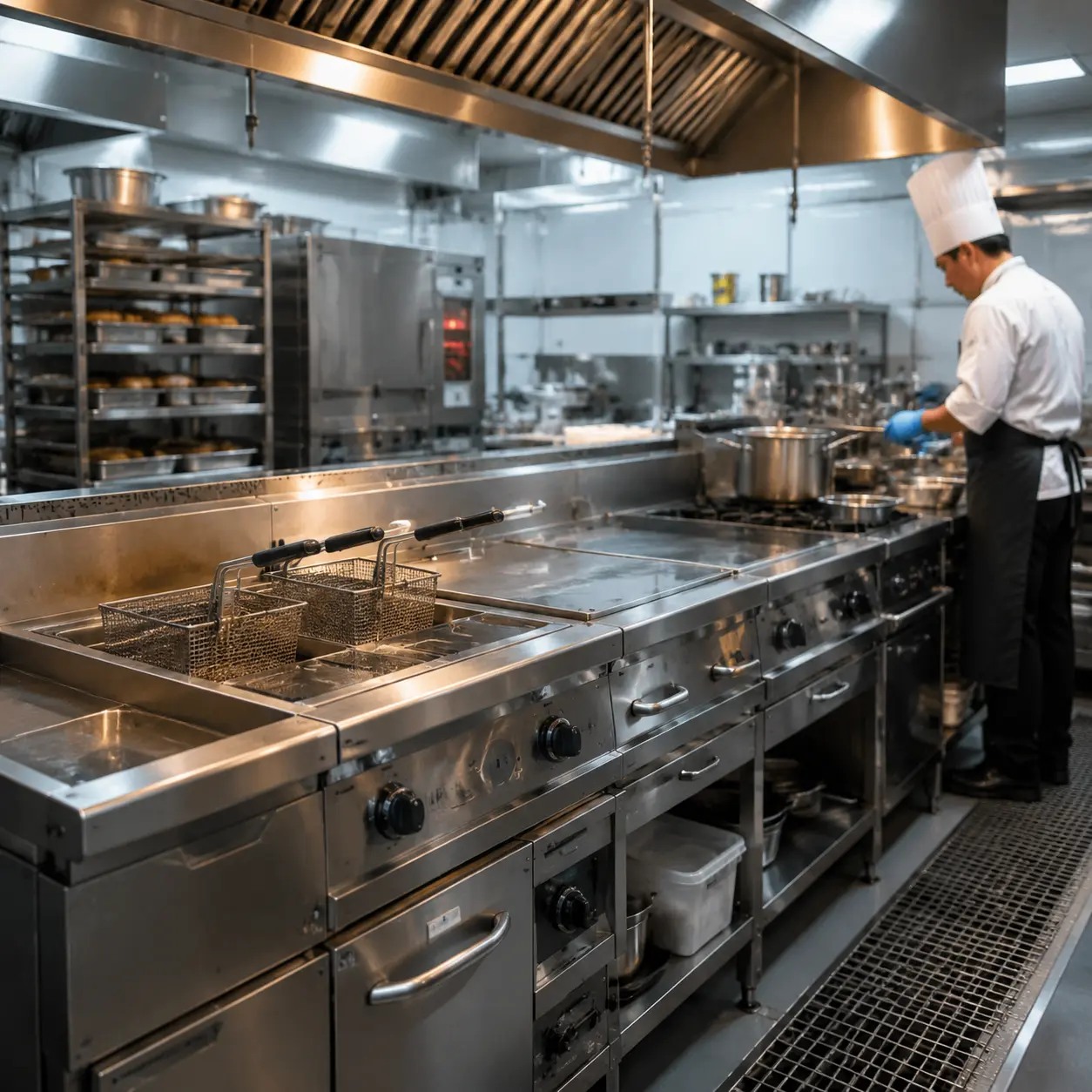
Commercial kitchen equipment for foodservice buyers
Applications and Workflow Fit
Commercial kitchen equipment is applied differently across foodservice formats. A bakery may prioritize repeatable dough handling, oven loading, cooling, and rack movement. A hamburger shop may focus on griddle or fryer recovery, forming and preparation speed, chilled ingredient access, and compact service flow. A hotel or institutional kitchen may need flexible batch production, holding, redundancy, and compatibility with scheduled meal periods. A distributor serving several markets may need multiple electrical versions, regional documentation, replacement parts, and packaging suitable for long-distance shipping.
Before purchasing, map the menu from receiving through storage, preparation, cooking, holding, service, cleaning, and waste handling. Identify the step with the greatest volume or longest cycle time. That step may determine the required equipment capacity. Also check whether the equipment can enter the site, fit through doors and elevators, connect to utilities, and be serviced without dismantling surrounding units.
Key Specification Vocabulary
- Capacity: The stated quantity, batch size, chamber load, storage volume, or output rate. Ask whether it is nominal, usable, maximum, or tested.
- Throughput: The quantity processed over a defined period under stated operating conditions. Throughput should include cycle time and recovery assumptions.
- Footprint: The equipment’s external dimensions. Confirm required clearances, door swing, service space, and ventilation space separately.
- Utility requirement: Voltage, phase, frequency, current, plug, gas type, gas pressure, water connection, drain, ventilation, or refrigeration requirement.
- Working range: The usable temperature, speed, humidity, pressure, or adjustment range, rather than a single headline setting.
- Food-contact material: The material and finish used on surfaces that contact food. Ask for the exact grade, thickness where relevant, finish, and cleaning limitations.
- Ingress protection: A rating describing resistance to solids and water under a defined test system. It should be confirmed from the technical documentation.
- Recovery: How quickly an appliance returns to its operating condition after a load is added or a door is opened.
- Documentation: Technical drawings, manuals, wiring diagrams, parts lists, declarations, test reports, and market-specific certificates or marks where required.
Safety documentation requires particular care. NSF maintains a portfolio of food equipment standards, but a standard, a certification listing, and a local approval are not interchangeable. Ask which exact model and configuration are covered, who issued the document, its validity or scope, and whether the destination authority accepts it. Do not publish a supplier’s general certificate as evidence for every product.

Commercial kitchen equipment for foodservice buyers
Questions to Include in a Commercial Quotation
Ask the supplier to quote the exact model, dimensions, materials, accessories, options, utility configuration, production assumptions, packaging method, gross and net weight, loading quantity, delivery term, lead time, installation boundary, warranty terms, spare-parts availability, and response process for service issues. Request drawings and manuals before approval when the equipment affects layout or utilities.
For a structured review, buyers can compare commercial kitchen equipment, review selected equipment, or request a commercial kitchen equipment quote from GZYF Metal. A complete inquiry should include destination country, menu, expected volume, available utilities, site dimensions, target delivery point, documentation requirements, and the service model expected after installation.
How to Make a Commercial Kitchen Equipment Decision
Choosing commercial kitchen equipment is not only a product comparison exercise. For an importer, distributor, restaurant group, or foodservice contractor, the decision must connect menu requirements, available utilities, installation conditions, destination-market rules, service expectations, and total ownership risk. A suitable unit should perform its intended task consistently and arrive with documentation that allows your team to verify what is being purchased.
Start with the operating requirement rather than a preferred product name. Define the food or beverage process, expected working schedule, available floor or counter space, utility connections, cleaning method, and staff workflow. A replacement project may prioritize dimensional compatibility and dependable parts availability, while a new store opening may require coordinated specifications across several equipment categories. A distributor expanding its catalog may also need repeatable models, packaging information, product photography, manuals, and private-label options.
What a Buyer Should Verify Before Ordering
Supplier literature is useful for shortlisting equipment, but it is not a substitute for a formal specification review. Ask the supplier to identify the exact model, configuration, materials, dimensions, utility requirements, included accessories, and applicable documents. If a specification is important to approval or installation, request it in writing on the quotation or technical data sheet.
- Model identity: Confirm the model number, revision, finish, configuration, and any regional variation.
- Physical fit: Check overall dimensions, working clearances, door or drawer movement, service access, and shipping dimensions.
- Utilities: Confirm voltage, frequency, phase, plug or connection arrangement, fuel type where relevant, water or drainage requirements, and site connection responsibilities.
- Construction: Ask which parts are stainless steel or other materials, how surfaces are finished, and whether removable components are included.
- Performance information: Request only the capacity, output, temperature range, recovery, or other performance data that the supplier can document for the selected configuration.
- Included scope: Identify shelves, trays, racks, casters, controls, filters, hoses, manuals, spare parts, and installation hardware that are included or excluded.
GZYF Metal presents product categories including baking equipment, hamburger shop equipment, refrigeration equipment, snack equipment, other kitchen equipment, and accessories. Buyers can use the company’s commercial kitchen equipment products page and equipment portfolio as starting points, then request model-specific documentation before making a commercial commitment.

Commercial kitchen equipment for foodservice buyers
Compliance and Documentation Boundaries
Compliance is market-specific. The destination country, state, province, municipality, building type, installation method, and product category may all affect which approvals, labels, declarations, test reports, or inspection documents apply. Do not assume that a mark, certificate, or supplier statement accepted in one market automatically satisfies another market’s requirements.
NSF maintains a portfolio of food equipment standards, but the relevant standard and certification scope must be verified for the particular product and current market requirement. A buyer should ask whether a statement refers to certification of the complete equipment, a component, a manufacturing process, or a material. The quotation should also distinguish between “designed to meet,” “tested to,” “listed,” and “certified,” because these terms do not necessarily carry the same regulatory meaning.
Before issuing a purchase order, build a documentation checklist with the importer, installer, local authority, or compliance consultant. Depending on the market and equipment type, the file may need a product data sheet, user and maintenance manual, wiring diagram, installation instructions, packing list, country-of-origin information, declaration or certificate, test report, and replacement-parts list. If documentation is unavailable, record that gap as a pre-order condition rather than treating it as an administrative detail.
What Should Be Included in the Commercial Quotation?
A clear quotation reduces disputes between the factory, importer, distributor, installer, and end customer. At minimum, request the following items in one written quotation:
- Exact model numbers, quantities, configurations, and product descriptions.
- Unit price, currency, quotation validity, payment terms, and any minimum order quantity.
- Incoterm or delivery responsibility, estimated production timing, packing method, and shipment information.
- Included accessories, optional accessories, spare parts, manuals, labels, and private-label elements.
- Inspection or approval procedure, including what documents are supplied before shipment.
- Warranty duration, coverage boundaries, exclusions, claim procedure, and responsibility for labor, freight, and replacement parts.
- Recommended maintenance items, consumables, critical spare parts, and expected service channel.
Do not compare two quotes by headline price alone. A lower price may exclude accessories, export packing, documentation, installation support, replacement parts, or service labor. Ask the supplier to identify every exclusion. For multi-unit projects, request a line-item equipment schedule so substitutions can be detected before production.
Parts, Warranty, and After-Sales Support
Service support should be evaluated before purchase, especially when equipment will be installed in a market far from the manufacturing location. Ask which parts are considered wear items, whether exploded diagrams or parts lists are available, how parts are identified, and how a service claim is initiated. Confirm whether technical support is provided by the manufacturer, distributor, installer, or another party.
Warranty language should answer practical questions: When does coverage begin? What proof of purchase is required? Who diagnoses the failure? Who pays for shipping? Are labor and travel included? What happens if a part is unavailable? A written answer is more useful than a general promise of support. For a distributor, these details also determine whether the product can be supported profitably after resale.
GZYF Metal describes capabilities in product development, design, sheet-metal processing, laser cutting, bending, laser welding, and equipment manufacturing. These are manufacturer-context claims rather than proof of a particular product’s certification, capacity, or service terms. Buyers should connect the stated capabilities to the specific model, drawings, inspection requirements, and after-sales arrangement requested in the quotation.

Commercial kitchen equipment for foodservice buyers
Practical Decision Framework
- Define the use case: Record the menu, workflow, operating schedule, location, and target market.
- Screen the fit: Remove models that cannot meet the space, utility, access, cleaning, or installation requirements.
- Verify the evidence: Match important claims to drawings, manuals, test documents, samples, or written supplier confirmation.
- Review compliance: Confirm the documents and approvals required by the destination market before production.
- Normalize quotations: Compare identical scope, accessories, delivery terms, warranty coverage, and documentation.
- Plan support: Establish the parts list, service contact, warranty process, and replacement strategy.
- Approve in writing: Keep the final specification, quotation, drawings, labels, and approved changes in one purchase file.
For project teams comparing shortlisted units, the compare commercial kitchen equipment function can help organize product review. Buyers can also save equipment for later review or review selected equipment before sending a consolidated inquiry.
Frequently Asked Questions
Can a supplier prove every specification?
A responsible supplier should be able to provide written specifications for the selected model, but the available evidence may differ by claim. Request drawings, manuals, test reports, certificates, photographs, or samples as appropriate. Treat unsupported performance or compliance claims as unverified.
Which documents apply in my market?
That depends on the destination market, equipment category, installation, and local authority. Confirm requirements with the importer, qualified installer, certification body, or regulatory adviser before ordering. Do not rely on a generic certificate without checking its scope and validity.
What is usually included in the quote?
Never assume that accessories, installation, freight, taxes, manuals, labels, spare parts, or commissioning are included. Require an itemized quotation with explicit inclusions and exclusions.
How should I evaluate parts and warranty support?
Ask for the warranty terms, claim workflow, parts-identification method, service contact, and recommended critical spares. Confirm responsibilities for diagnosis, labor, freight, and replacement components in writing.
Next Step for Buyers
Prepare a specification brief before contacting a supplier. Include the destination market, intended application, quantity, dimensions, utilities, compliance documents, branding needs, delivery target, and support expectations. Then request a commercial kitchen equipment quote with those requirements attached. For background on the manufacturer, review the Guangzhou Yifeng Metal manufacturing background and ask the supplier to confirm which capabilities and documents apply to your selected equipment.
References
- NSF Food Equipment Standards — reference for the existence of NSF’s food equipment standards portfolio; verify the current applicable standard and certification scope.
- GZYF Metal commercial kitchen equipment — company product categories and attributed manufacturing-context information.
- GZYF Metal product pages — product-level information to verify against a formal quotation.