 (+035) 527-1710-70
 NEWSLETTER


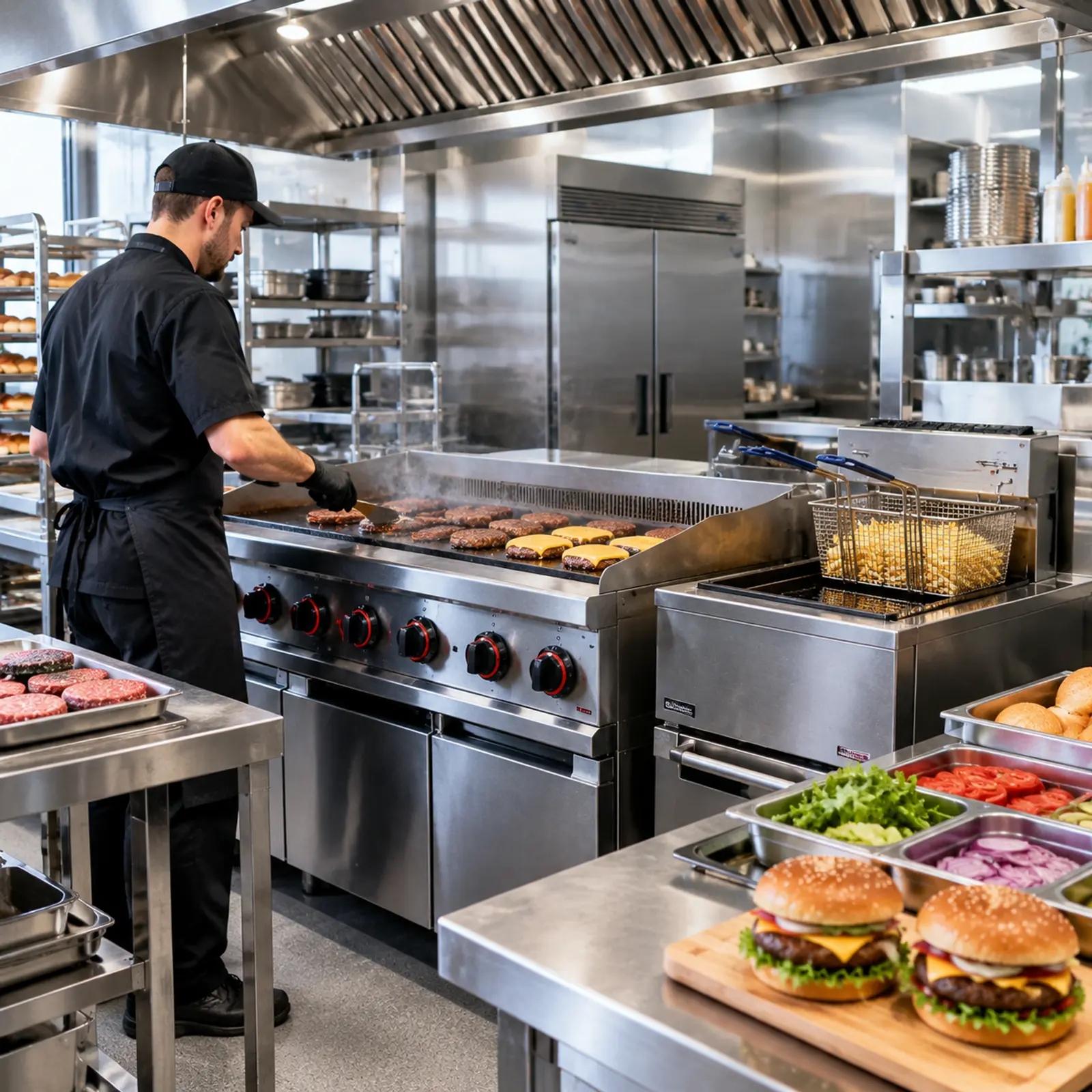
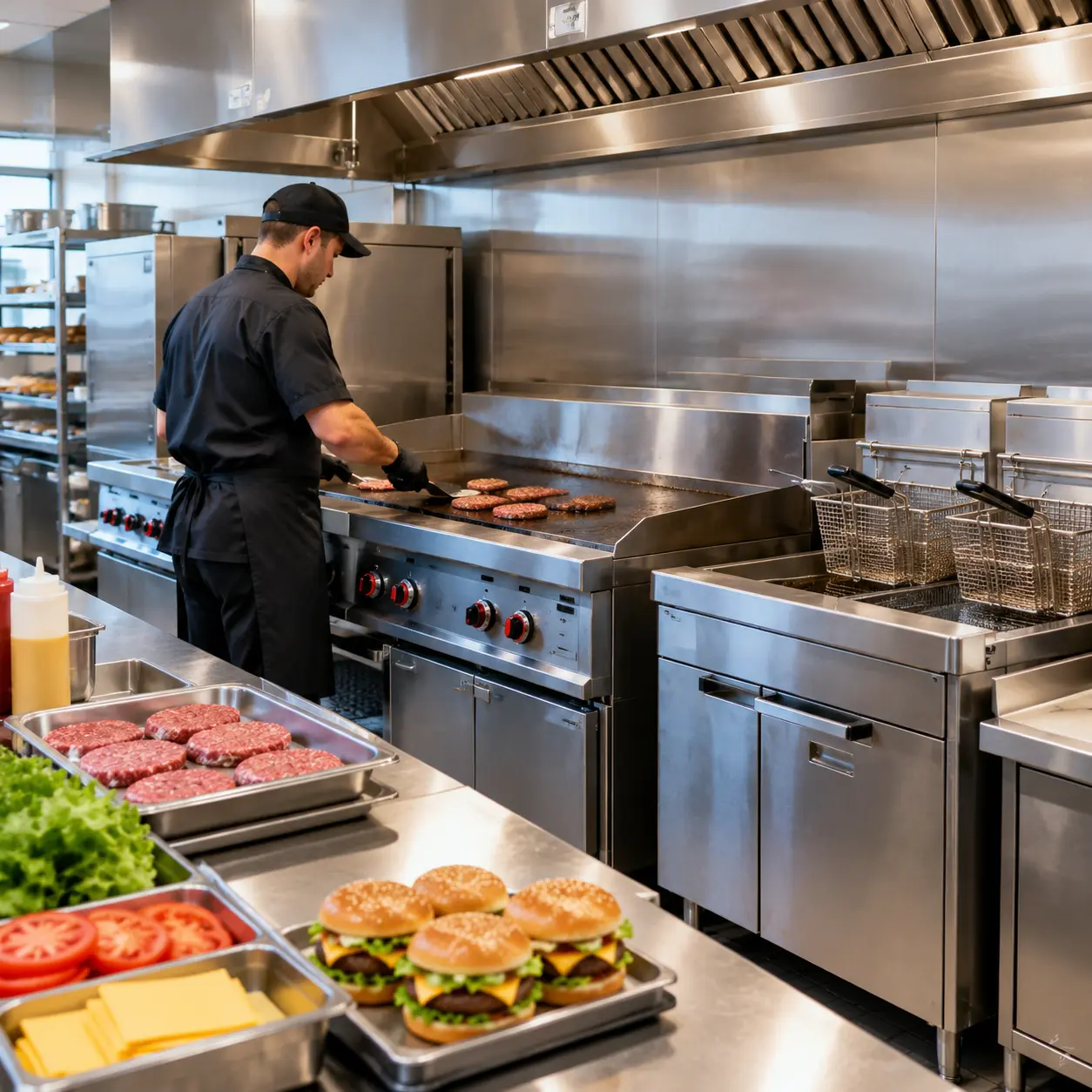
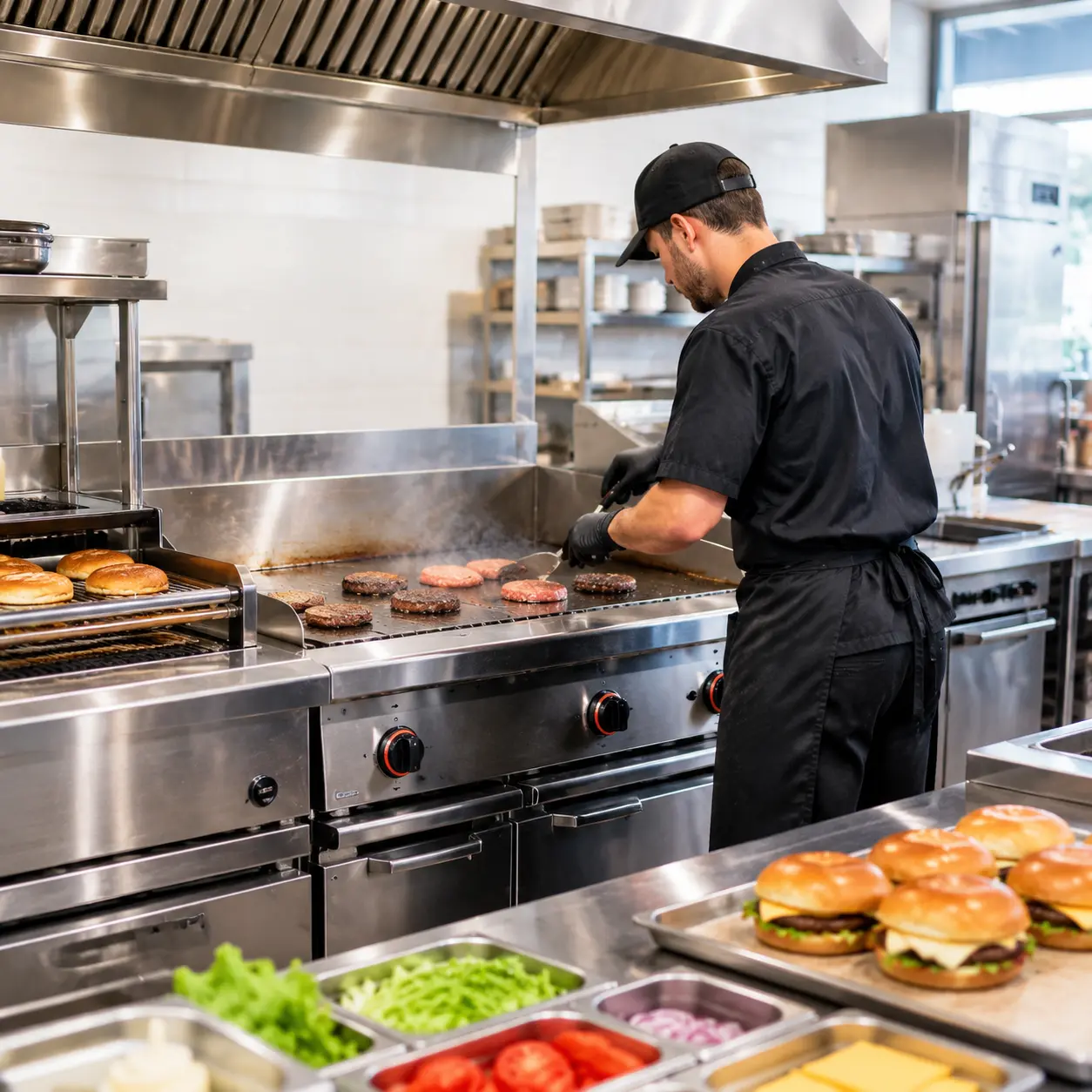
Hamburger shop equipment is the commercial cooking, preparation, refrigeration, holding, ventilation, and service equipment used to produce and sell hamburgers and related fast-food menu items. It may include griddles, fryers, refrigerated preparation counters, freezers, bun toasters, heated holding units, stainless-steel worktables, sinks, ventilation equipment, and smallwares. The exact equipment package depends on the menu, expected throughput, kitchen layout, labor model, available utilities, destination-market requirements, and budget.
The term describes a working equipment group, not one standard machine or a complete restaurant by itself. A hamburger shop may require only a compact griddle and undercounter refrigerator, or it may need a larger line with multiple cooking appliances, cold storage, preparation refrigeration, fry production, holding, washing, and customer-facing service equipment.
Definition and Boundaries
Hamburger shop equipment is designed for repeated commercial food production. It differs from household appliances through its intended duty cycle, construction, cleaning requirements, controls, installation method, and service expectations. However, “commercial” does not automatically mean that every item is suitable for every market or operating environment. Buyers must confirm electrical frequency, voltage, gas type, plug or terminal configuration, drainage, ventilation, water connection, and local approval requirements.
Hamburger shop equipment is also not limited to burger cooking. A practical equipment package supports the complete production flow:
- Receiving and storing meat, buns, vegetables, sauces, frozen products, and packaging.
- Preparing patties, toppings, sauces, and garnishes.
- Cooking patties, bacon, eggs, vegetables, and other menu items.
- Frying potatoes, chicken, seafood, or other items when included on the menu.
- Toasting buns and assembling orders.
- Holding selected foods for short service periods under the operator’s food-safety procedures.
- Cleaning equipment, utensils, work surfaces, and food-contact areas.
It is not a substitute for a kitchen design, a ventilation plan, a fire-protection review, or a local food-safety assessment. Equipment selection should be coordinated with the site, installation contractor, and authority having jurisdiction where applicable.
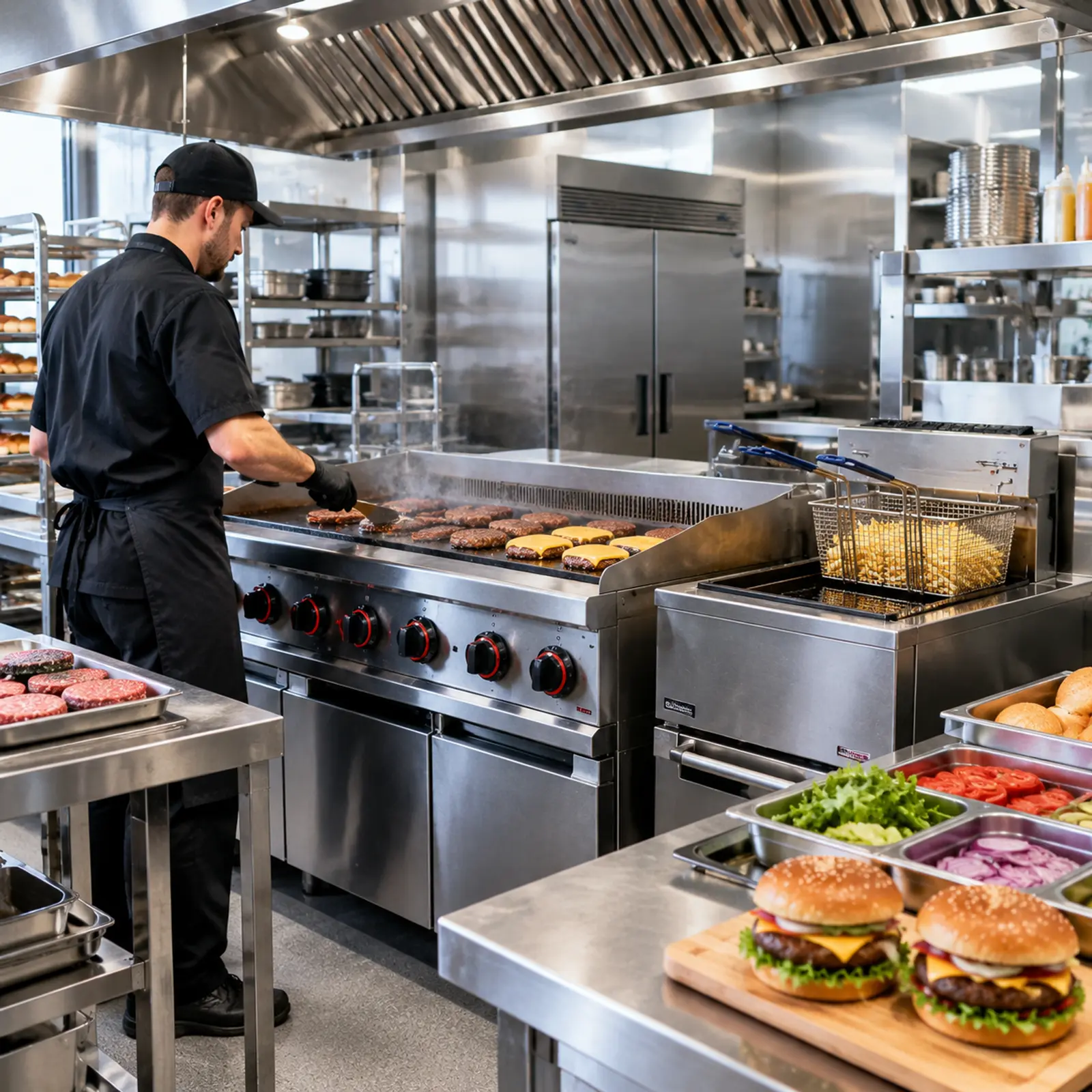
Commercial kitchen equipment for foodservice buyers
How Hamburger Shop Equipment Works
A hamburger shop line converts raw or prepared ingredients into finished orders through controlled heat, cold storage, preparation, and holding stages. Refrigeration slows temperature increase during storage and preparation. Cooking equipment transfers heat to the food through a heated metal surface, hot air, oil, or another approved cooking medium. Holding equipment maintains prepared food or components for a limited service window according to the operator’s procedures and the equipment manufacturer’s instructions.
For example, a griddle heats a flat cooking surface so patties can contact the surface directly. The result depends on surface temperature, recovery after loading, cooking time, product thickness, batch size, and operator technique. A fryer transfers heat through oil and requires attention to oil volume, filtration, cleaning, and safe handling. A refrigerated prep counter combines cold storage with a work surface and ingredient pans, allowing an operator to assemble burgers while keeping ingredients organized.
The equipment works as a system. A high-output griddle may be poorly matched with insufficient refrigeration, limited extraction, or a small preparation area. Likewise, a large fryer may not improve operations if the menu has low fried-food demand or if the site cannot support its power, gas, ventilation, drainage, or fire-protection needs.
Main Types of Hamburger Shop Equipment
Cooking Equipment
Griddles are commonly used for burger patties, bacon, eggs, and vegetables. Buyers may compare smooth, ribbed, or combination cooking surfaces, heating zones, control method, cooking-area dimensions, splash protection, grease management, and cleaning access. Charbroilers or broilers may be selected when the menu and cooking method require direct radiant heat or a grilled surface.
Fryers are used for French fries and other fried products. Important purchasing details include fryer type, basket arrangement, oil capacity, heating method, temperature control, filtration options, drain design, and required clearances. The buyer should obtain the manufacturer’s installation and operating requirements before assuming that an appliance can be connected to the planned utility system.
Preparation and Refrigeration Equipment
Preparation equipment includes stainless-steel worktables, cutting and assembly surfaces, sinks, ingredient containers, shelving, and refrigerated prep counters. Refrigeration equipment may include undercounter refrigerators, upright cabinets, freezers, refrigerated drawers, or cold storage used for ingredients and prepared components.
For importers, the quotation should distinguish internal storage volume from usable storage volume and should identify temperature-control features, refrigerant information where relevant, shelf or drawer configuration, door swing, external dimensions, and packing dimensions. A capacity statement without its measurement basis is difficult to compare across suppliers.
Bun Toasting, Holding, and Display Equipment
Bun toasters and conveyor toasters support faster assembly when toasted buns are part of the menu. Heated holding cabinets, pass-through warmers, heat lamps, and other holding units may be used for selected cooked items or assembled orders. Holding equipment should not be treated as a replacement for correct cooking, rapid service, or the operator’s food-safety controls.
GZYF Metal lists baking equipment, hamburger shop equipment, refrigeration equipment, snack equipment, other kitchen equipment, and accessories among its product categories. Its website also describes product development, sheet-metal processing, laser cutting, bending, laser welding, and equipment manufacturing capabilities. Buyers should request the exact model documentation and configuration rather than relying on a category name alone. The company’s equipment portfolio can be used as a starting point for discussing a package.
Ventilation, Washing, and Support Equipment
Cooking appliances may require an exhaust hood, filters, ductwork, make-up air, fire protection, or other site services. These requirements vary by appliance, fuel, building, and jurisdiction. Support equipment can include hand-washing stations, warewashing equipment, waste containers, shelving, storage racks, ingredient bins, and service counters.
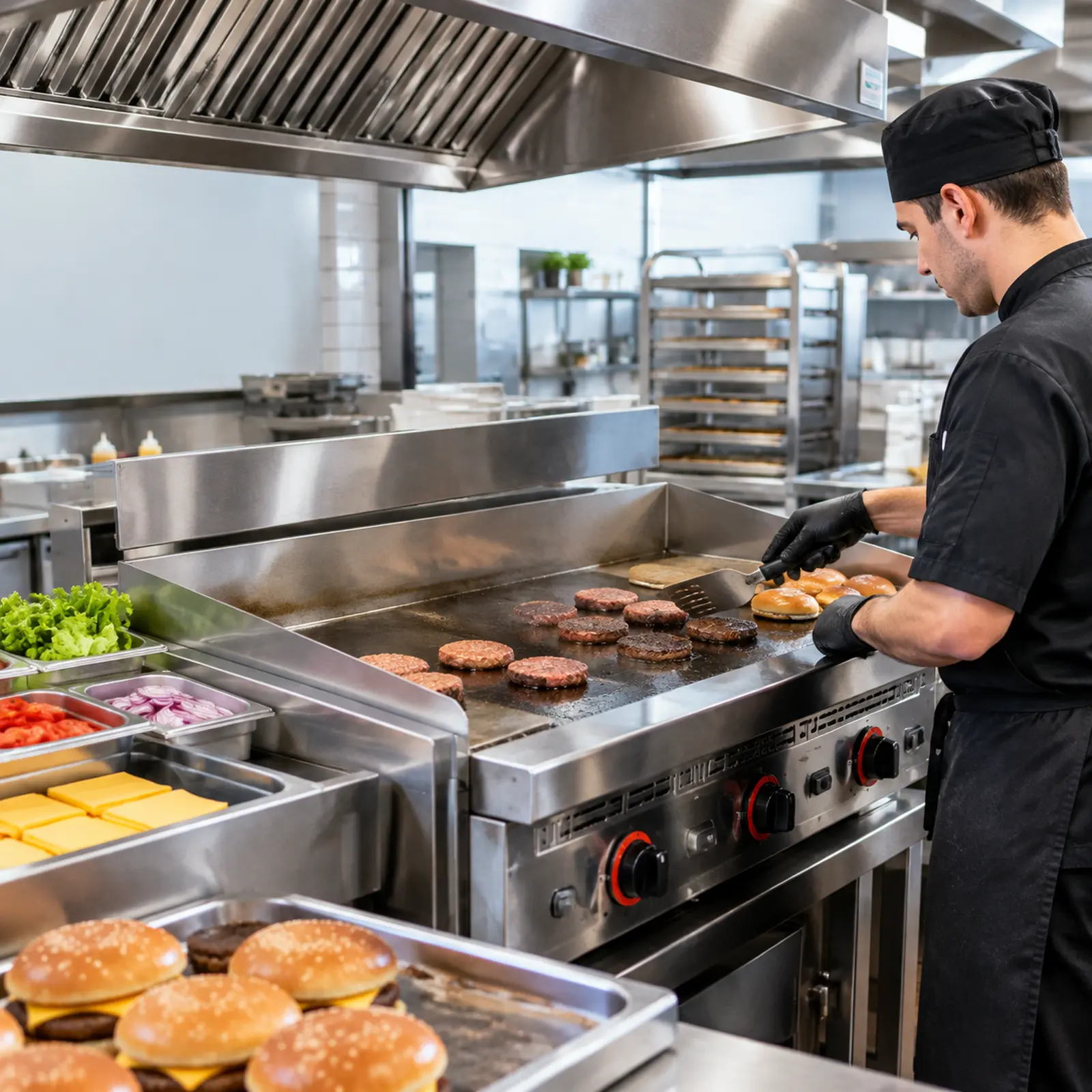
Commercial kitchen equipment for foodservice buyers
Applications
Hamburger shop equipment can be configured for independent burger restaurants, quick-service chains, food courts, kiosks, hotel outlets, canteens, convenience stores, mobile or temporary food operations, and delivery-focused kitchens. The same menu may require different equipment in each application.
A compact kiosk may prioritize a small footprint, simple cleaning, limited utilities, and rapid assembly. A high-volume restaurant may prioritize cooking-area size, recovery behavior, separate preparation zones, redundancy, and service access. A delivery kitchen may allocate more space to cold preparation, packaging, and order staging than to customer-facing display. A distributor serving several countries should maintain separate configuration records for voltage, frequency, plugs, gas connections, language requirements, documentation, and approval marks.
Key Specification Vocabulary
| Term | What the buyer should clarify |
|---|---|
| Nominal capacity | The supplier’s stated volume, load, or production figure and the test conditions behind it. |
| Throughput | Output over a stated period, including product size, loading pattern, recovery time, and operating assumptions. |
| Cooking area | The usable surface dimensions, not only the appliance’s outside dimensions. |
| Power input | Voltage, phase, frequency, amperage, plug or terminal arrangement, and connected load. |
| Fuel specification | Gas type, inlet pressure, connection size, and whether conversion is permitted or available. |
| External dimensions | Width, depth, height, door clearance, service clearance, and whether handles or fittings are included. |
| Net and gross weight | Equipment weight for installation and packed weight for freight planning. |
| Food-contact materials | The materials and finishes used on surfaces that contact food or cleaning chemicals. |
| Recovery behavior | How the equipment responds after loading product, with the measurement method clearly stated. |
| Service access | How technicians reach controls, heating elements, refrigeration components, drains, and replaceable parts. |
Certification should be handled as a document-verification task. NSF explains that food equipment certification relates to sanitation and applicable evaluation requirements; buyers should verify the exact product, model, certification scope, and destination-market acceptance through the relevant certification body. Do not treat a general supplier statement, a logo image, or a certificate for another model as sufficient evidence. Safety documents, wiring diagrams, manuals, declarations, test reports, and installation instructions should be included in the quotation package where applicable.
Questions to Include in a Quotation Request
- What menu items, portion sizes, peak orders per hour, and operating hours support the capacity claim?
- Which dimensions are usable, and which dimensions include handles, doors, casters, or fittings?
- What are the exact utility requirements and site clearances?
- What safety, sanitation, electrical, gas, or EMC documents are available for the destination market?
- What consumable and spare parts are recommended for the first operating period?
- What warranty terms, remote support, technician requirements, and response process apply?
- Does the price include packaging, export documentation, inland transport, freight, insurance, installation, commissioning, or taxes?
- What is the lead time for the quoted configuration, and how are changes handled after order confirmation?
A complete inquiry should identify the menu, expected throughput, site plan, utilities, destination country, delivery term, documentation requirements, and preferred service model. Importers can then request a commercial kitchen equipment quote with a configuration that is specific enough to compare against competing offers. Related products, such as a commercial food warming display cabinet, should be evaluated as part of the service and holding workflow rather than purchased as isolated items.
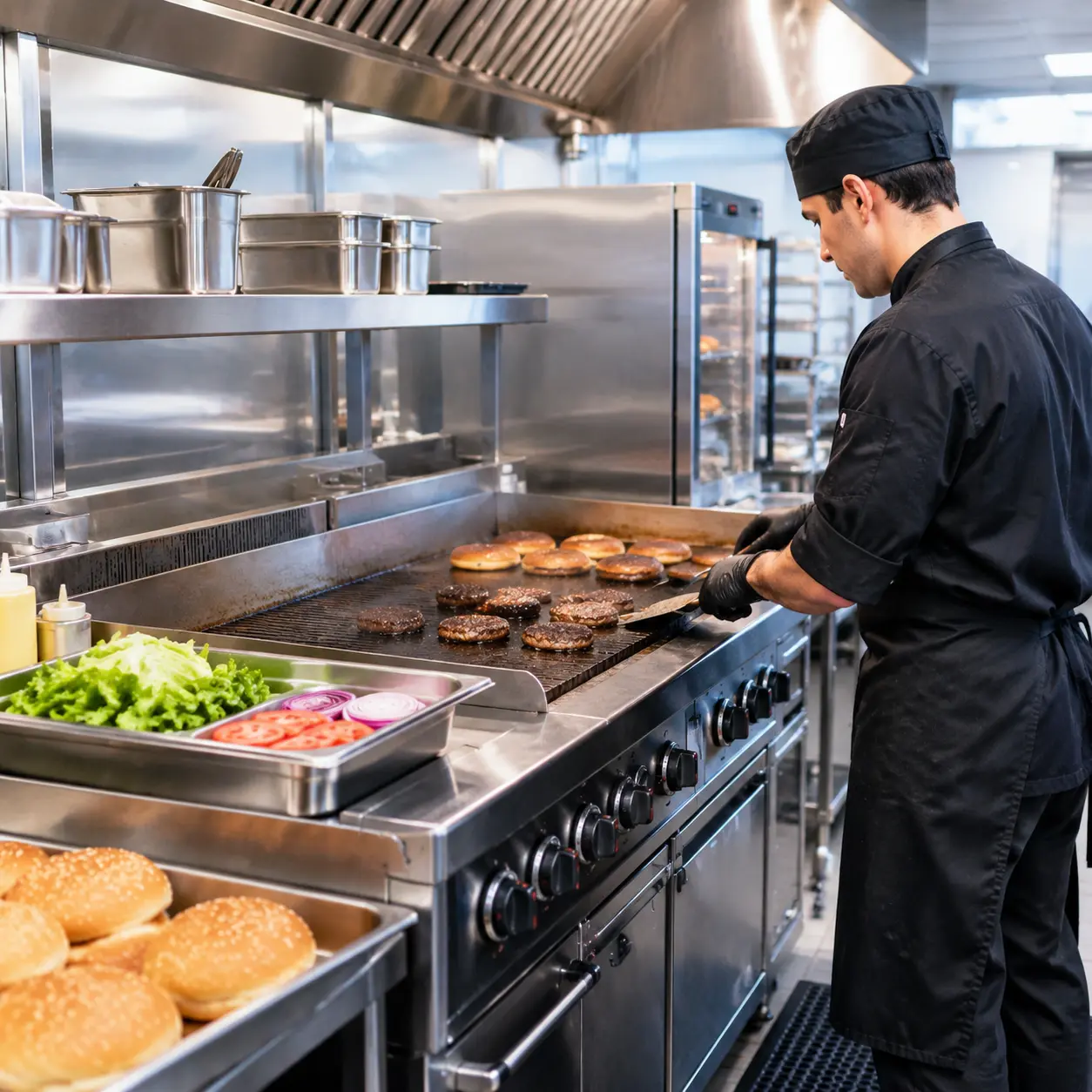
Commercial kitchen equipment for foodservice buyers
How to Make a Hamburger Shop Equipment Decision
The right hamburger shop equipment package depends on the menu, service volume, kitchen layout, utility conditions, local compliance requirements, and expected maintenance support. A buyer opening a new store may need a coordinated equipment package, while an established operator may only need to replace one unreliable unit. A distributor or private-label buyer has an additional concern: whether the supplier can provide repeatable specifications, documentation, packaging, and replacement parts.
Start with the workflow rather than a product name. Map the sequence from chilled storage and preparation to cooking, holding, assembly, order handoff, cleaning, and waste handling. This helps prevent a common purchasing error: selecting individual units that appear suitable but do not fit the available space, electrical service, ventilation plan, or production sequence.
Match the Equipment Package to the Buying Trigger
- New store opening: Confirm the complete equipment schedule, utility requirements, footprint, installation access, and commissioning responsibilities before placing an order.
- Menu expansion: Identify whether the new products require additional cooking, cold storage, preparation, holding, or display capability. Do not assume existing capacity will support the added menu.
- Replacement of unreliable equipment: Compare the failed unit’s actual operating requirements with the proposed replacement. Check dimensions, connection points, controls, cleaning access, and spare-parts availability.
- Distributor catalog expansion: Request consistent product data, images, manuals, packaging details, lead times, and model identification so the catalog can be maintained accurately.
- Private-label development: Define the approved drawings, materials, finish, branding locations, packaging, inspection process, and change-control procedure before production begins.
- Destination-market compliance: Establish which electrical, sanitation, labeling, import, and installation documents are required in the market where the equipment will be sold or used.
Guangzhou Yifeng Metal Technology Co., Ltd. describes its business as commercial kitchen equipment manufacturing and exporting from Baiyun District, Guangzhou, Guangdong, China. Its stated portfolio includes baking equipment, hamburger shop equipment, refrigeration equipment, snack equipment, other kitchen equipment, and accessories. Buyers can use the GZYF Metal equipment portfolio to identify relevant product categories, then confirm whether a proposed package is available as standard equipment or requires a customized quotation.
Commercial kitchen equipment for foodservice buyers
What the Supplier Should Prove
A product page or quotation is not a substitute for technical verification. Ask the supplier to identify the exact model, revision, materials, dimensions, net and shipping weight, utility requirements, operating controls, included accessories, and installation limitations. Where performance matters, request the test method and the conditions under which the result was obtained. If a specification is not documented, treat it as unconfirmed rather than filling the gap with an assumption.
For custom or private-label equipment, request an approval drawing before production. The drawing should show overall dimensions, service clearances, connection locations, door swings or access panels, branding areas, and any customer-supplied components. A final inspection checklist and product photographs can help confirm that the shipped unit matches the approved configuration.
The company describes capabilities including research and development, design, sheet-metal processing, laser cutting, bending, laser welding, and equipment manufacturing. These are manufacturer-stated capabilities; the buyer should still verify which processes, materials, tolerances, and quality checks apply to the specific model being quoted.
Compliance and Safety Boundaries
Compliance is market-specific. Before ordering, provide the destination country, installation location, voltage and frequency, plug or connection expectations, and the authority or distributor requirements that apply. Ask which documents are supplied with the unit and which must be obtained by the importer, installer, or operator.
NSF explains that food equipment certification addresses applicable public-health requirements for commercial food equipment. Use the NSF food equipment certification resource to understand the certification issue, but do not describe a product as NSF certified unless the exact model and certification status can be verified through appropriate documentation.
Certification is only one part of a safe installation. Equipment must also be installed by qualified personnel where required, connected to the correct utilities, positioned with required clearances, and operated according to the supplied instructions. The operator remains responsible for food handling, cleaning, temperature control, employee training, and local health-code compliance. A quotation should clearly separate factory documentation from site-specific approvals and installation work.
What to Include in a Quotation Request
A useful request makes competing quotations easier to compare. Include the product category and intended use; expected menu and workflow; available footprint; utility information; destination market; required quantity; preferred materials or finish; branding needs; delivery location; target timing; and any inspection or documentation requirements.
Ask the supplier to list, line by line:
- Exact model numbers and revision or configuration identifiers
- Dimensions, materials, finish, controls, and utility requirements
- Included accessories, shelves, trays, racks, cords, fittings, or other components
- Optional items and items excluded from the quoted price
- Packaging method, shipping dimensions, gross weight, and delivery terms
- Production lead time, sample or approval stages, and order-change deadlines
- Manuals, wiring information, drawings, certificates, inspection records, and labeling
- Warranty duration, warranty exclusions, service process, and replacement-parts policy
Also ask how parts are identified and ordered. A strong support process should connect each replacement part to a model and revision, state whether the part is stocked or made to order, and explain who pays shipping during a warranty case. Do not assume that a warranty includes labor, site visits, consumables, or return freight unless the quotation says so.
Commercial kitchen equipment for foodservice buyers
Buyer Checklist Before Approval
- Confirm that the proposed equipment fits the planned workflow and physical space.
- Verify utilities, access routes, ventilation assumptions, and installation responsibilities.
- Match every important requirement to a written specification or approved drawing.
- Confirm which compliance documents apply to the destination market and exact model.
- Separate included equipment from options, accessories, installation, freight, and taxes.
- Agree on inspection, packaging, labeling, warranty, and spare-parts procedures.
- Keep the final quotation, drawings, manuals, and approved configuration together as the purchasing record.
For a coordinated review of available categories, visit the GZYF Metal equipment portfolio. Buyers can also request a commercial kitchen equipment quote with the operating and documentation details above. Existing product selections can be organized before buyers review selected equipment or complete your equipment inquiry.
Frequently Asked Questions
Can a supplier prove the quoted specification?
Ask for a model-specific datasheet, drawing, utility information, inspection record, and test method where performance is claimed. For customized equipment, obtain written approval of the final configuration before production.
Which documents apply in my market?
Requirements depend on the destination market, equipment type, utilities, and installation. Give the supplier the destination and intended use, then confirm certification, labeling, electrical, sanitation, import, and installation requirements with the relevant authority or qualified local professional.
What is normally included in the quote?
Do not rely on the word “complete.” Require a line-item list showing the exact unit, accessories, options, packaging, freight terms, documentation, installation scope, taxes, and exclusions.
How should I assess parts and warranty support?
Request the warranty terms, exclusions, response process, parts list, model identification method, lead times, and shipping responsibility. Confirm whether support is provided by the manufacturer, distributor, importer, or installer.